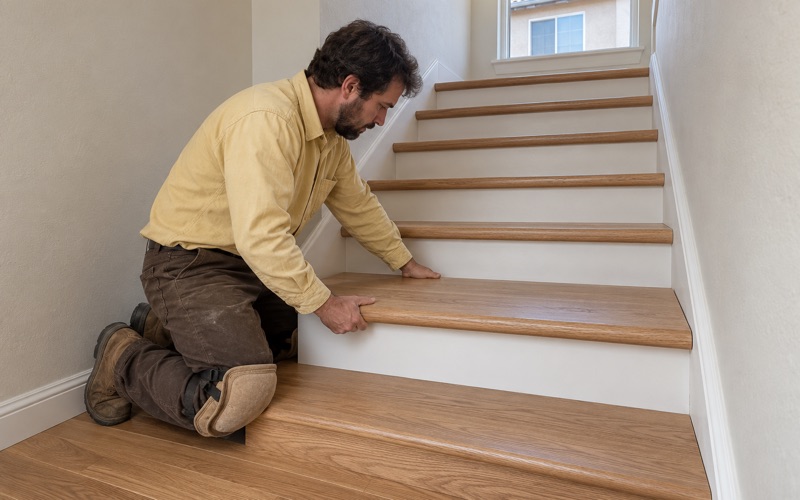
Hawthorne Wood Flooring has handled wood flooring in Westmont for more than 20 years, and a growing share of our calls here come from people buying their first house rather than from landlords. A purchase puts floors on a deadline. Some questions have to be answered before escrow closes, and others are better left until the furniture is in and the household has lived on the boards for a season.
We help buyers sort one list from the other. That usually starts during the inspection window: lifting a corner of carpet, reading moisture in the wood, and checking the subfloor before anyone prices a finish. A buyer who knows what is under the carpet can negotiate with better information, plan a realistic budget and avoid an expensive surprise the week after moving in.
Everything we write for a buyer is itemized: the repair, the materials, the labor and the reason for each line. That paper travels well. A lender, an inspector or a seller’s agent can read it without calling us, and it becomes the starting record for every later floor project in the house. The sections below walk through how that works on an older Westmont purchase.
Buying a First Home in Westmont Through the County Program
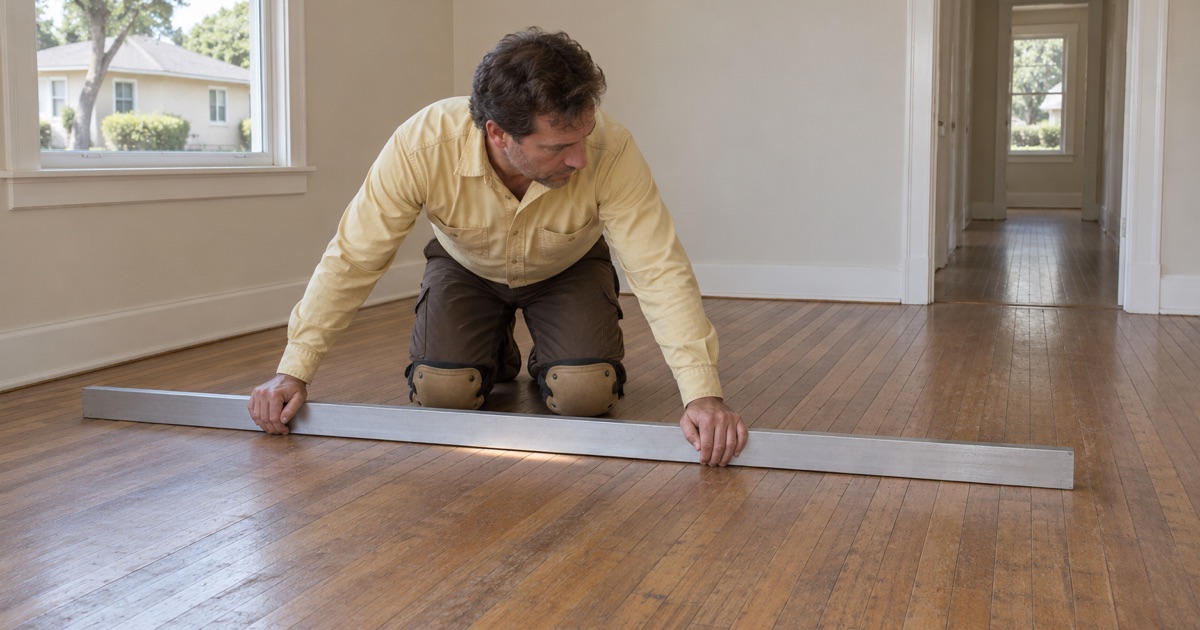
Westmont is an unincorporated community in Los Angeles County, just east of Inglewood, and its name comes from its position west of Vermont Avenue. It is mostly a place of renters: only 28.3 percent of its occupied units are owner-occupied. The housing is old, too. Census estimates put 79.2 percent of its units before 1980 and 41.3 percent before 1950.
That combination shapes the buyers we meet. Someone purchasing here for the first time is very likely buying a house that has already had several owners, several remodels and several layers of flooring. The floor they see at the open house is rarely the only one in the room, and the one underneath is usually the one that decides the budget.
What the Home Ownership Program Offers
The Los Angeles County Development Authority runs a Home Ownership Program for first-time buyers. Its HOP80 and HOP150 tiers offer assistance up to $100,000 or 20 percent of the purchase price, whichever is less, for single-family homes, condominiums and townhomes in unincorporated Los Angeles County or in participating cities. Whether a particular buyer and house are approved is the County’s decision, never ours.
The assistance is a 0 percent loan with deferred repayment and shared equity, repaid when the home is sold, transferred or no longer owner-occupied. A first-time buyer, under the program’s definition, has had no ownership interest in real estate in the past three years. Buyers also complete an eight-hour homebuyer education seminar from a HUD-approved counseling agency.
Two Conditions That Reach the Floor
Two of the program’s property conditions matter to anyone who works on floors. Every property built before 1978 must have a visual lead-based paint inspection and pass it before approval. And all health and safety issues on the home inspection report must be repaired before escrow closes. Neither rule mentions flooring by name, and we do not tell buyers that a floor defect falls under the second one.
What the two rules do is compress the calendar. In a house this age, repairs that turn up during inspection often sit where floors meet walls, doors, stairs and plumbing. When a repair list carries a deadline tied to closing, it helps to know early whether any of it touches the floor, who will do that work, and when they can start.
Reading the Inspection Report With the Floor in Mind
We read a buyer’s inspection report the way a floor installer reads it. A note about a soft spot near the tub, a sloping hallway, a stain around the water heater closet or a raised edge at a doorway can each point to the subfloor, a floor joist or a leak. Deciding what counts as a health and safety item belongs to the inspector and the program; our job is to say what the floor shows.
Looking for wood-flooring closer to Manhattan Beach? See Manhattan Beach Wood-Flooring.
Old Finishes and the Lead Inspection
The 1978 line in the program is the same line the EPA Renovation, Repair and Painting rule draws, and so much of Westmont’s housing sits on the older side of it. The program’s inspection is visual and is about paint. Our part is narrower: carrying out floor work in a pre-1978 house so that it does not disturb the paint on trim, baseboards and stair parts along the way.
Baseboards, Shoe Molding and Stair Skirts
Floor jobs touch painted wood more than most people expect. Shoe molding comes off before sanding, baseboards get brushed by an edger, and stair skirts and risers are often painted in layers that go back decades. In pre-1978 houses we follow lead-safe work practices around that trim: plastic sheeting, dust kept inside the work area, and cleanup with a HEPA vacuum instead of a broom.
Timing matters as much as method. If the program’s visual inspection is still ahead, we would rather not pull trim or sand anything until it is done, because we do not want our work to change what the inspector sees. We schedule removal work once the buyer and their agent confirm the inspection has been passed, and the estimate notes that sequence in writing.
Old Tile, Black Mastic and Painted Floors
Older houses also hide older flooring. Under carpet or sheet vinyl in a kitchen or hallway we may find 9x9 tile or black mastic, and we treat either one as a possible asbestos question before anything is sanded or scraped. That means an asbestos survey first, with any removal handled under SCAQMD Rule 1403, instead of a grinder. A buyer should hear about that possibility before closing, not after.
Painted wood floors are the other common surprise. Back porches, rear bedrooms and closets sometimes carry paint rather than a clear finish, and in a pre-1978 house that paint gets the same lead-safe treatment as the trim does. We would rather test, contain and plan the work than sand first and discover afterward what the dust was carrying.
Every one of these findings goes into the written estimate with the room, the material and the approach we recommend. If the buyer decides to leave an old tile floor covered for now, the estimate says so plainly. The next contractor who works in the house then has a documented starting point instead of a guess about what lies under the vinyl.
Floor Repairs Before Escrow Closes
Not every floor problem found during escrow has to be fixed before closing, and not every one can wait. The difference usually comes down to whether the problem is still getting worse. A finish that has turned orange with age is cosmetic. A board cupping next to the dishwasher is a symptom, and whatever is causing it will keep working after the buyer moves in.
Soft Spots and the Subfloor
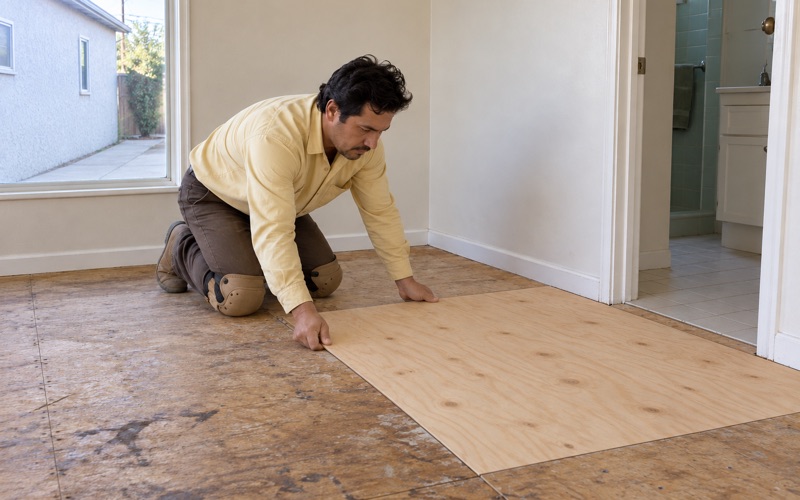
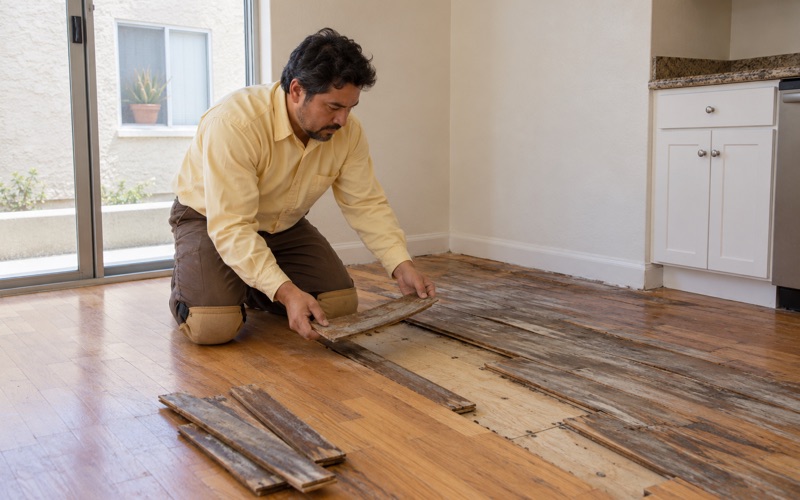
We open and check the subfloor before pricing any finish floor. In a house built before 1950, that can mean plywood patches over older plank sheathing, joists that were reinforced during an earlier remodel, or sheathing that swelled after a long-ago leak. A soft spot at a bathroom door tells us to look underneath, and what we find decides which list the repair belongs on.
If a soft spot turns out to be rot around a toilet flange or a failed shower pan, that becomes a plumbing and framing question first, and the floor comes last in the sequence. We document what we see with dated photos and moisture readings, so the buyer, the inspector and the seller are all looking at the same evidence when they talk about who fixes what.
Leaks, Moisture and Written Readings
Water is the most common reason a floor repair gets pulled forward. We trace water damage back to its source, whether that is a supply line, a water heater or, in a condominium or townhome, the unit upstairs. Then we measure moisture content in the wood with a wood moisture meter, and where there is a concrete slab we use an ASTM F2170 in-situ relative humidity test or a calcium chloride test.
Those numbers go on paper with the date and location of every reading. If an insurance claim or a seller credit is part of the negotiation, the adjuster or agent receives readings they can actually use. And if the source has not been repaired yet, we say so directly: new boards laid over an active leak will cup, crown or buckle the same way the old ones did.
Loose Boards, Nosings and Transitions
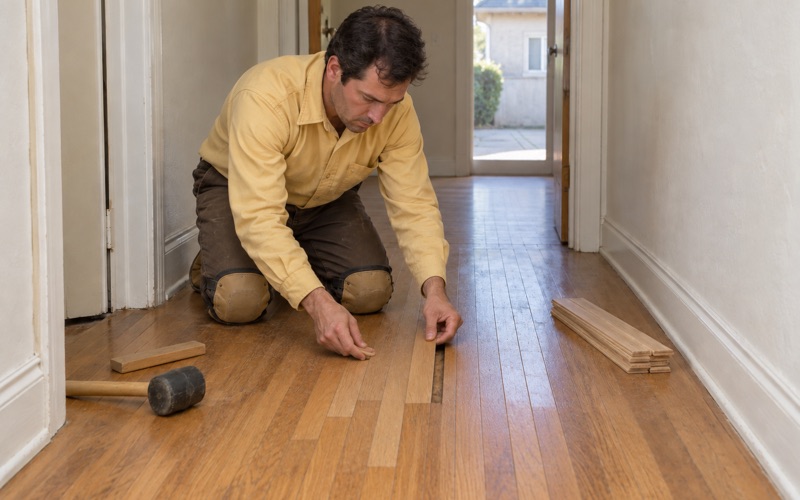
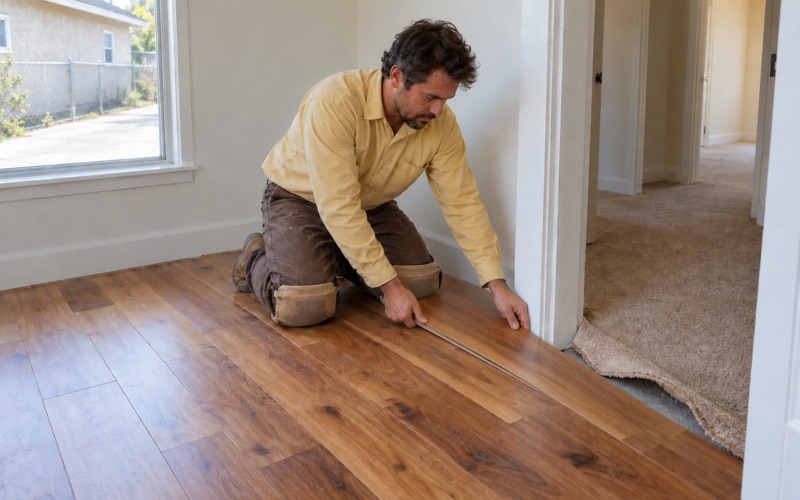
Some floor items are simply about walking safely: a lifted board at a threshold, a cracked stair nosing, or a transition strip that has worked loose between tile and wood. These are small jobs, usually a board replacement or a new reducer strip or T-molding, and buyers often want them settled early. We price stairs per tread and riser, so one loose nosing never arrives disguised as a square-foot number.
Floor Projects Worth Waiting For
Once the keys change hands, the deadline disappears and the bigger floor decisions can be made on the household’s own schedule. The 2020 census counted 42.6 percent of Westmont households with children under 18, and plenty of first-time buyers move in with kids, pets and a lease ending somewhere else. The best refinishing jobs are planned around that life rather than squeezed into escrow.
Finding Oak Under the Carpet
Many older houses have hardwood under wall-to-wall carpet, and the only way to learn its condition is to pull the carpet up. We lift the carpet pad, staples and tack strip and fill the holes before sanding, so oak found under carpet refinishes clean. Pet urine stains, board gaps, termite frass and kick-out holes all show up at this stage, and each one changes the plan.
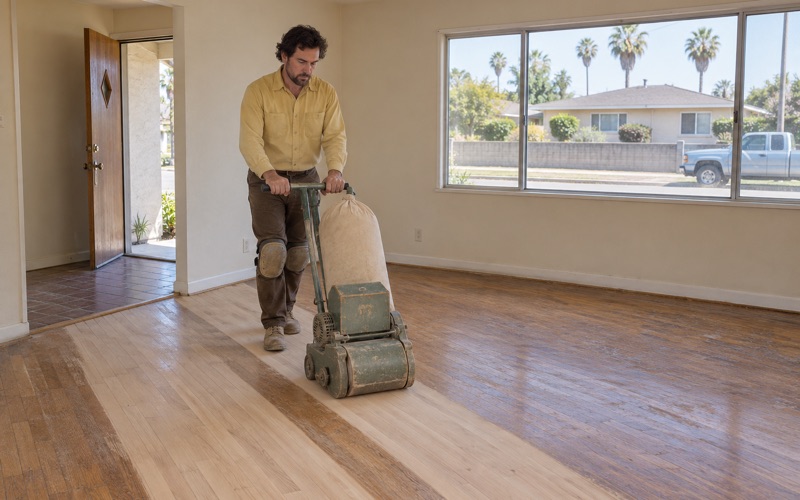
Where the oak is sound, a full sand with a drum sander, an edger and an orbital sander, run through a planned grit sequence, brings it back. Where a few boards are ruined, a weave-in repair ties new wood into the existing field so the patch disappears under the finish. In an occupied house we use a dustless sanding system, and the lead-safe steps described earlier still apply to the trim.
Finishes, Cure Times and a Household Living In
Finish choices are easier once people live in the house and know how it gets used. Waterborne polyurethane, oil-modified polyurethane and hardwax oil each wear, smell and cure differently, and the sheen level changes how scratches read in daylight. Every finish we apply is chosen from products legal in the South Coast air basin under SCAQMD Rule 1113 and its 275 g/L wood coatings limit.
We contain the dust and write out a cure schedule: when each room can be walked on in socks, when furniture can go back, and when a bedroom can be slept in again. A household that knows that schedule can usually stay in the house through the work, which matters to a new owner carrying a mortgage payment and no spare place to stay.
Replacement and Bigger Changes
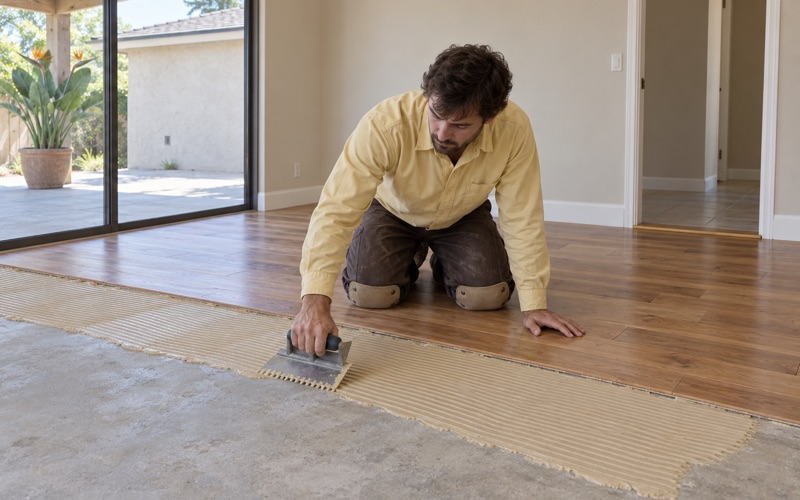
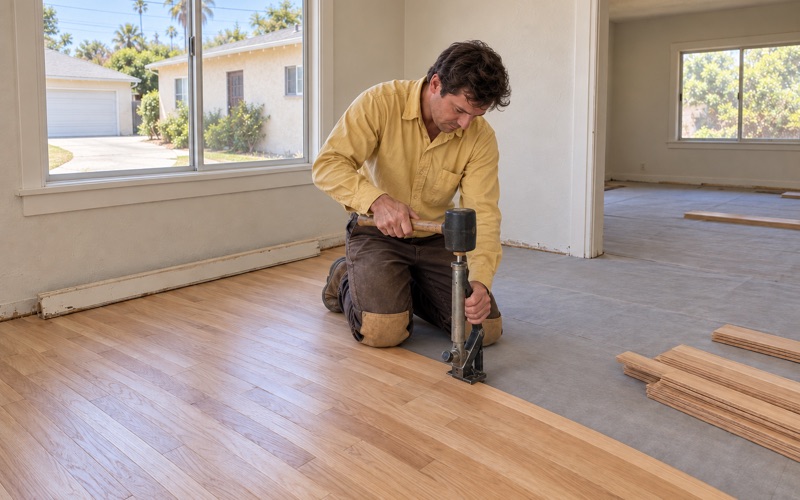
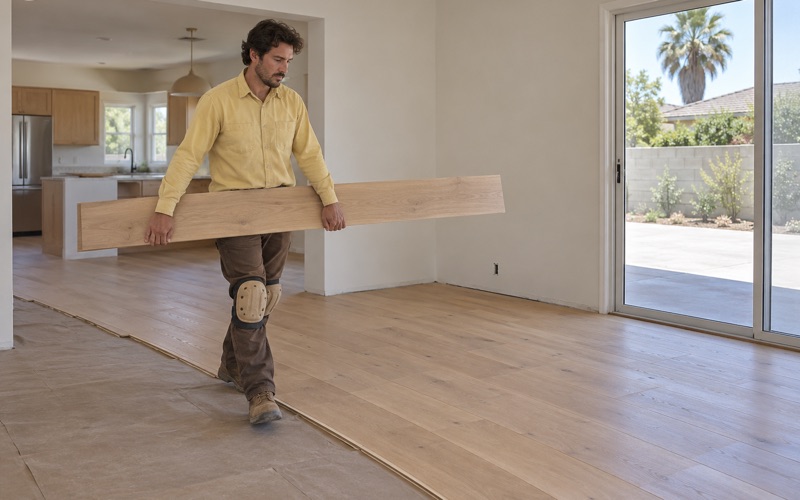
Replacing floors outright is a later decision for most buyers. When the time comes, we measure moisture before ordering, allow for acclimation, and follow NWFA installation guidelines for nail-down, glue-down or floating installations. We compare Janka hardness, wear layer thickness and engineered core construction, so the buyer chooses a floor for how the house is lived in rather than how the listing photos looked.
Whatever order a buyer chooses, the paper from the escrow visit carries forward. The subfloor notes, moisture readings and trim findings mean the second visit begins where the first one ended. Nothing we already found gets investigated or paid for twice, and the buyer can plan each later project against a written record of the house instead of starting from memory.
- 20+ Years With Wood Floors
- Written, Itemized Estimates
- Low-VOC South Coast Finishes