Hawthorne Wood Flooring has handled wood flooring in West Rancho Dominguez for more than 20 years, and much of that work happens in houses that someone rents. We repair, refinish and replace floors for owners who lease out a single house, and we do it on the turnover date the owner sets, with a finish chosen to hold up between tenants.
Every job starts with the floor itself rather than a price per square foot. We walk every room, note what is worn and what is damaged, and hand over an estimate that lists each repair on its own line. An owner, a property manager and a tenant can all read the same sheet and see what is being fixed, what it costs and why.
This page is for the owner of a rented house and for the household living in one. It covers what the County’s routine habitability inspections mean for a floor, how we scope a repair when a correction notice arrives, and the ordinary upkeep that keeps a rental floor from turning into a notice in the first place.
Rented Houses Under a County Inspection Cycle
A Rental Market Built on Houses
West Rancho Dominguez is an unincorporated community in southern Los Angeles County, west of Compton, also known as East Gardena and counted as West Compton in the 1970 census. Its rental stock looks different from most apartment-heavy markets. Of 2,293 renter households, 1,352 live in detached houses, which is 59.0 percent of everyone who rents here.
That shapes our work. A rented house has one owner deciding on the floor, a tenant who lives on it every day, and rooms that see years of furniture, pets and traffic between refinishes. The floor has to be scoped for the whole house, not a single unit, and it has to survive the tenancy that follows.
The Rental Housing Habitability Program
In September 2024 the County announced that its Rental Housing Habitability Program would cover rental properties with two or more units and tenant-occupied single-family homes in unincorporated areas. Inspections began in November 2024, run by the Department of Public Health’s Environmental Health division, and a rented house here falls inside the program’s reach.
Routine inspections come around once every four years. When an inspector records a violation, the landlord has 21 days to correct it. The program also responds to complaints about rental units between routine visits, so the four-year cycle is the minimum, not a promise that nobody will look at the house sooner.
What the Program Costs an Owner
The annual program fee is $86 per rental unit, billed with the property taxes. Landlords may pass half of it through to the tenant, which works out to $3.58 a month. For an owner, the fee is fixed; the cost that varies is what a floor needs when an inspector writes it up.
That variable cost is where we come in. A floor repaired on the owner’s schedule, with time to acclimate material and cure a finish properly, costs less and lasts longer than one rushed against a deadline. The rest of this page is about keeping it that way.
Looking for wood-flooring closer to Redondo Beach? See Wood-Flooring Services in Redondo Beach.
What a Worn Floor Looks Like to an Inspector
Damaged Floors on the List
A news account of the program’s launch lists damaged walls or floors among the conditions inspectors examine, along with infestations, lead paint and missing hot or cold water. The County has not published a floor standard we could read, so we do not promise any result. What we can do is find and fix what a careful eye would call damage.
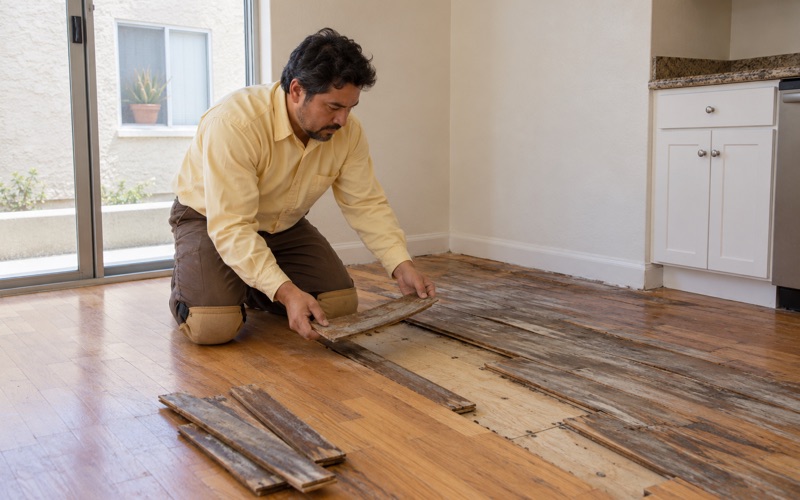
In a wood floor that usually means boards that are cracked, split or broken through, raised edges and cupping that catch a foot, loose or missing sections, soft spots that give underfoot, and finish worn down to bare wood where water can get in. Board gaps wide enough to trap debris and squeaks from loose fasteners fall in the same conversation.
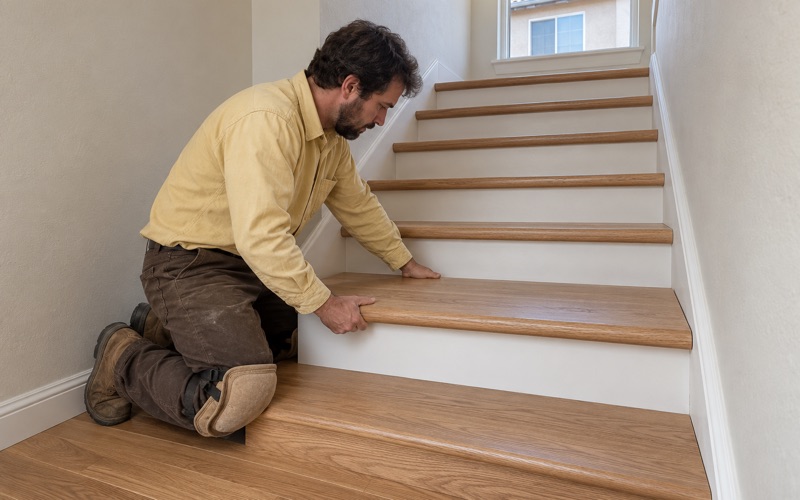
We also look at the stairs, where a house has them. A loose tread or a worn nosing is a safety matter in its own right, and on a stair the damage concentrates on the edges people step on most. We price stairs per tread and riser rather than folding them into a square-foot figure, so the owner sees what each step costs.
An Older Housing Stock
Of 6,985 housing units in West Rancho Dominguez, 65.6 percent were built before 1960. Floors in houses that age have usually been sanded more than once, covered with carpet at some point, and patched by whoever owned the house in between.
Each of those histories leaves something behind. Repeated sanding thins the wear layer until a board will not take another full sand. Carpet leaves pad, staples and tack strip, which we lift and fill before sanding so the oak underneath refinishes clean. Old patches often use a different species or thickness, which shows up as a ridge or a color break.
Lead and Asbestos in Older Houses
Because 87.2 percent of the housing units here predate 1980, most houses fall inside the pre-1978 window where the EPA Renovation, Repair and Painting rule can apply. Painted baseboards, shoe molding and thresholds get lead-safe handling from us before any sanding starts, with dust contained and cleaned up with a HEPA vacuum.
Old 9x9 floor tile and black mastic under a later floor are a separate question. We treat them as a possible asbestos issue and stop before scraping or sanding, so the owner can arrange an asbestos survey. It adds a step, but it keeps a floor repair from becoming a much larger problem inside an occupied house.
Scoping a Repair Inside a Correction Window
Twenty-One Days, Counted Backward
A 21-day correction deadline is workable for most floor repairs if the scope is settled early. We plan it backward from the deadline: the finish needs time to cure, new boards need time to acclimate, and material has to arrive before either can start. The first few days go to inspection, measurement and ordering.
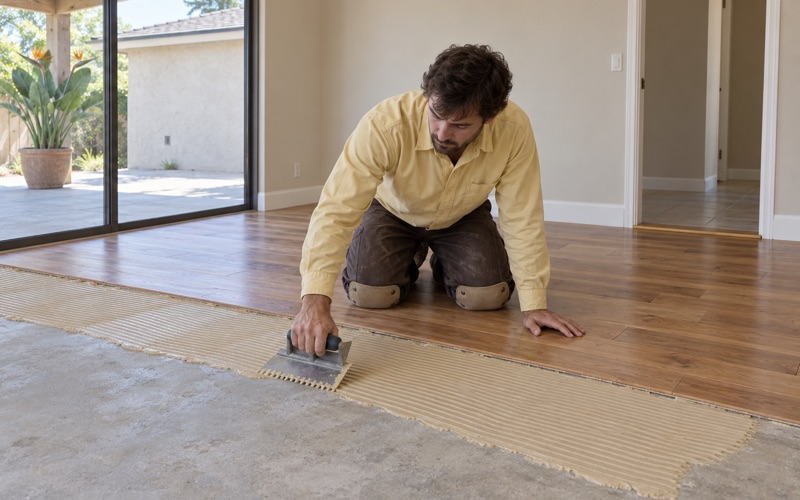
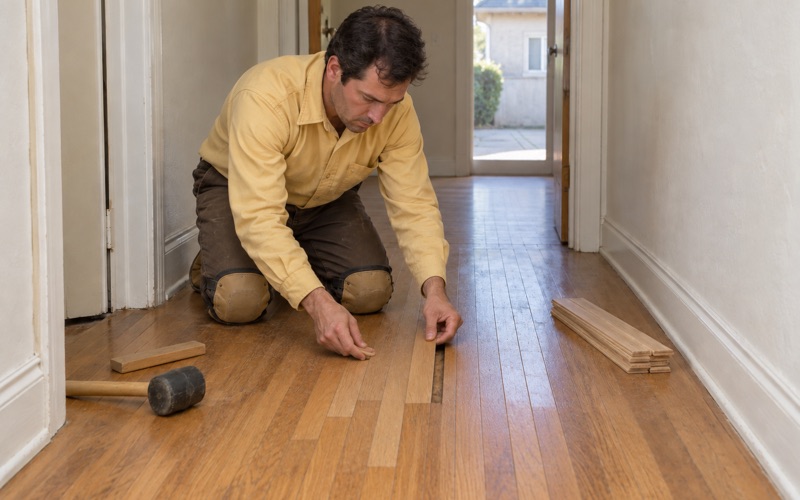
For that reason we visit as soon as a notice arrives, open the floor where needed, and write the scope that day or the next. A glue-down or nail-down board replacement, a weave-in repair and a screen and recoat each have different timelines, and the owner should know which one the house needs before committing to a date.
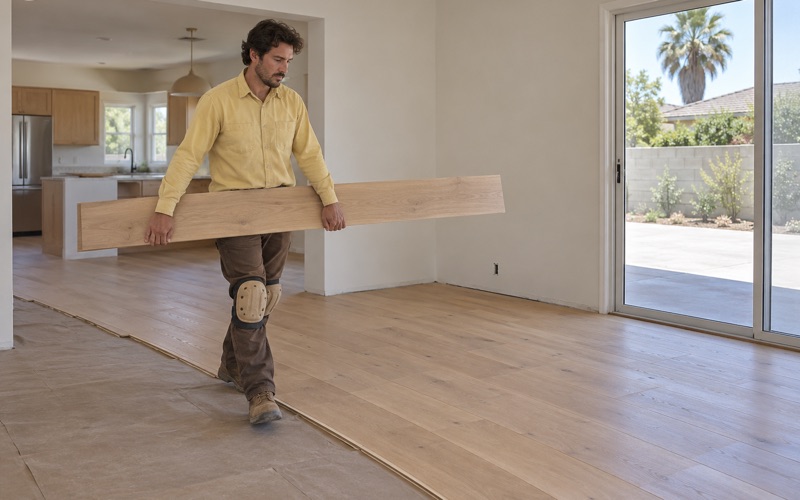
Acclimation is the step most often skipped under pressure. We bring new boards into the house, check their moisture content against the existing floor with a wood moisture meter, and install only when the two agree closely enough to follow NWFA installation guidelines. Skipping it saves a few days and costs gaps or cupping by the next season.
Opening the Floor Before Pricing It
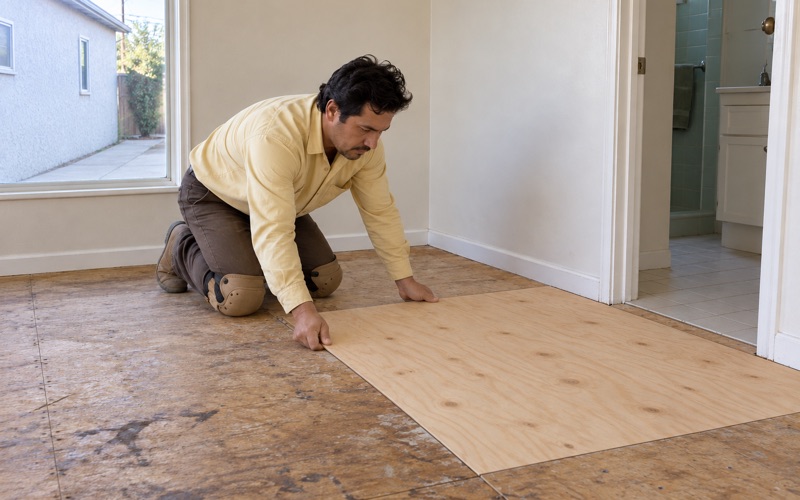
A damaged board is often a symptom. We open and check the plywood subfloor and the floor joists under the damage before we price the finish floor, looking for water-swollen sheathing, soft spots and loose framing. Pricing only the visible boards is how a repair gets redone months later.
When water is involved, we trace it to the source first. A plumbing leak, a failed toilet seal or a door threshold letting rain in will ruin new boards as quickly as it ruined the old ones. We document what we find with photos and moisture readings an insurance adjuster can use if the owner files a claim.
Paperwork an Owner Can Use
Every estimate and invoice we write is itemized: boards replaced by the square foot, stairs by the tread and riser, sanding, finish coats and any subfloor repair on their own lines. That record serves the owner showing work was done inside the correction window, and it serves again at move-out, when Civil Code 1950.5 requires itemized repair costs for any deposit deduction.
We keep the readings as well. Moisture content in the wood, and in any concrete under the floor, is measured before material is ordered and written into the file. If the same room shows trouble at the next inspection, the owner has a dated baseline showing what the floor looked like after the repair.
Keeping a Rental Floor Sound Between Inspections
Refinishing on Turnover
The best time to work on a rental floor is the gap between tenants. An empty house lets us sand, stain and finish every room at once, and it gives the finish its full cure before furniture comes back. We schedule to the turnover date the owner gives us, with a written cure schedule showing when each room is ready.
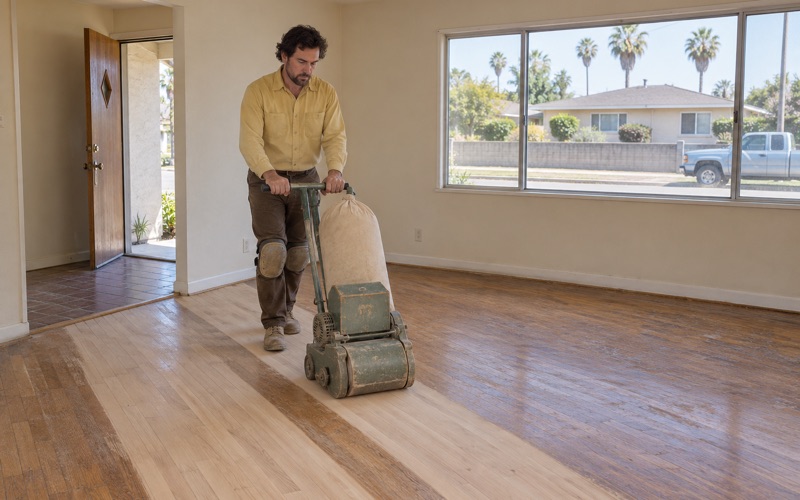
When the wear is only in the finish, a screen and recoat restores protection for far less than a full sand, and it saves the wear layer for later. When boards are gray, stained or bare, a full sanding with a drum sander, edger and a proper grit sequence is the right call. We tell the owner which one the floor needs.
Finishes That Survive a Tenancy
For rental floors we lean toward a durable waterborne polyurethane in a satin or matte sheen, which hides scratches and daily wear better than gloss. Every product we apply is legal in the South Coast air basin under the SCAQMD Rule 1113 wood-coating limit of 275 g/L, so a tenant is not breathing a banned finish while it cures.
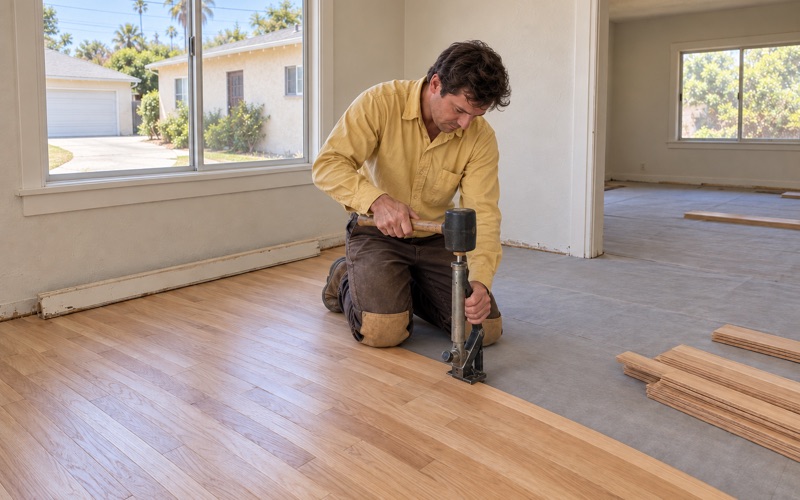
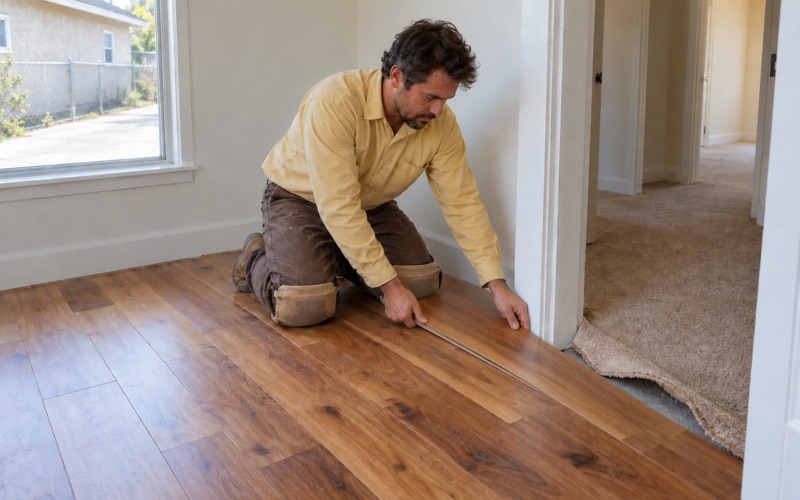
When boards are replaced, matching what is already down matters more than anything else. We identify the species, width and thickness in the room, whether red oak, white oak or something else, and source to match so the repair disappears into the floor. Where new material is chosen outright, we weigh its Janka hardness rating against the traffic it will see.
Where a household stays in the house during work, we contain dust room by room and tell them each morning which rooms are out of use. Pet urine stains, deep gouges and water rings are handled with board replacement rather than sanded over, since a stain that runs through the wood returns under a new coat.
Small Fixes Before They Grow
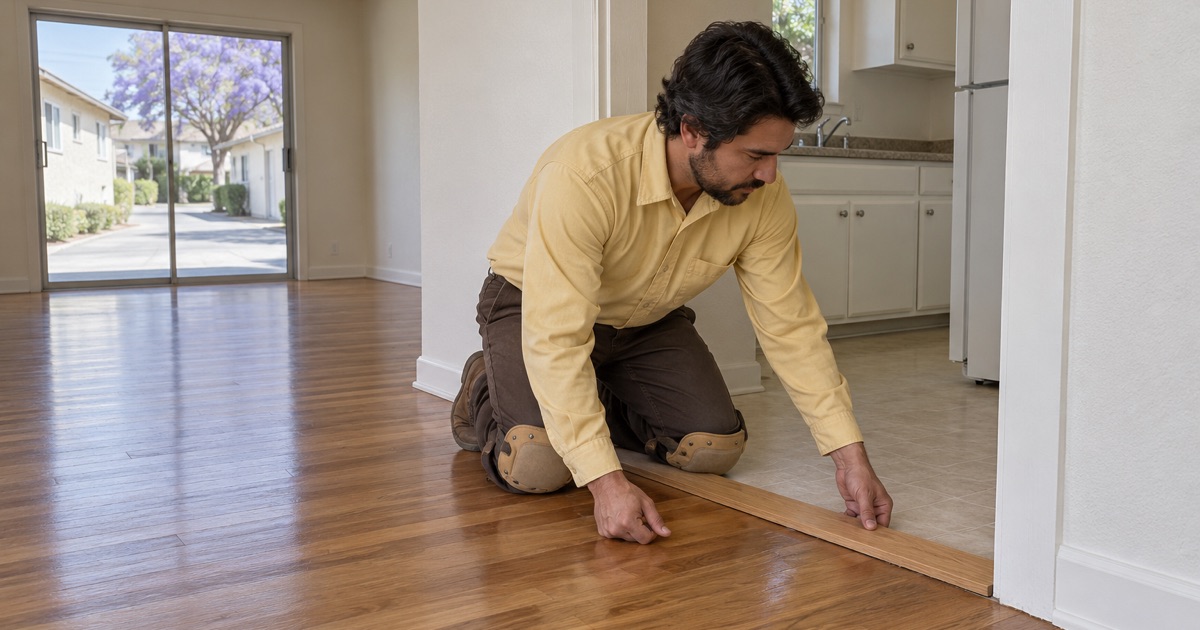
Between inspections, the problems worth catching early are the small ones: a squeak that means a loose fastener, a board lifting near a sink, gaps opening beside an exterior door, finish worn through in a hallway. Each one is inexpensive to fix on its own and becomes a larger repair once water or traffic gets underneath.
Tenants are part of this picture too. In West Rancho Dominguez, 511 renter households moved in during 2020 or later, and a tenant who reports a soft spot or a lifting board early gives the owner time to fix it on a schedule. We price those small repairs the same way we price a full refinish, in writing and line by line.
- 20+ Years With Wood Floors
- Written, Itemized Estimates
- Low-VOC South Coast Finishes