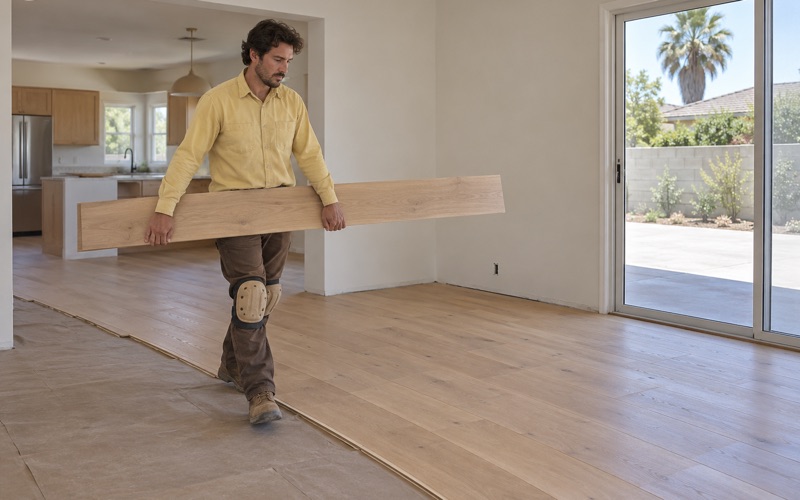
Hawthorne Wood Flooring has handled wood-flooring in Signal Hill and across this part of Los Angeles County for more than 20 years, and most of our work here happens inside houses and duplexes that people already live in or rent out. We refinish, repair and install hardwood, and every job starts with finding out what is actually under the carpet or the old finish before we price a thing.
That order matters most on a house whose history you do not fully know. Before a single board is ordered, we read the moisture in the wood and in any concrete, open the subfloor wherever it looks suspect, and write the numbers down. The estimate you get is itemized line by line, so an owner, a tenant or an adjuster can see exactly what was done and why.
Landlords make up a large share of our calls, and we plan around the turnover date they give us. Homeowners living through a job get dust containment and a written cure schedule that says when each room can take foot traffic, furniture and a bed again. Either way, the finish we apply comes from coatings that are legal to use in the South Coast air basin.
Floors in a City That Still Pumps Oil

Signal Hill covers 2.2 square miles on and around its hill, an enclave completely surrounded by Long Beach, and it was incorporated on April 22, 1924, roughly three years after oil was discovered there. That oil never fully left. The city’s Oil and Gas FAQ, updated March 25, 2025, counts approximately 400 oil wells throughout the city, including within seven consolidated drill sites.
For a flooring crew, that is background worth understanding rather than something to fret over. The wells are part of the neighborhood, from the pumping units some residents can see to the rules the city built around them. Our job is to know which of those rules attach to the kind of work we do, and which ones belong to builders and developers instead.
What the Methane Review Is Tied To
The FAQ says a Site Methane Assessment Report and Mitigation Plan is required for all projects citywide, whether or not there are known abandoned wells on site, before building permits are issued. The reason it gives is plain: methane has many sources besides oil operations. That review runs through a public process called Site Plan and Design Review under Chapter 16.24 of the Municipal Code.
The same FAQ answers who watches for leaks. The city monitors for methane when a project triggers it through development. For properties not under development, it relies on state authorities and local operators to watch for unauthorized gas releases and alert the city. Well abandonments themselves are overseen by the California Geologic Energy Management Division, known as CalGEM.
Where Floor Work Fits
The FAQ ties methane review to development and building permits. It says nothing about refinishing a living room or replacing boards in a hallway, and we will not guess on the city’s behalf. When a floor job is part of a larger remodel that alters framing, plumbing, electrical or mechanical systems, we ask the owner to confirm the permit picture with Building Safety before work starts.
Building Safety sits within the Community Development Department and reviews plans, issues permits and inspects. Effective October 28, 2024, the department is temporarily working out of the Council Chamber at 2175 Cherry Avenue. We would rather an owner make that call before we order material than learn halfway through a job that the wider scope needed a permit.
New Wells Stay Inside Drill Sites
Under Section 16.16.010 of the city’s Oil and Gas Code, new wells have been allowed only within approved drill sites since 1990. State law adds its own limit: SB 1137 bars new wells within 3,200 feet of sensitive receptors and calls for additional leak monitoring at existing wells inside that distance. New drilling, in other words, is confined to places that were already set aside for it.
Looking for wood-flooring closer to Artesia? See Wood-Flooring in Artesia.
Hilltop Homes Built Where Wells Were Capped
The FAQ is candid about how the city shrank its oil footprint: development. Building commercial centers, auto dealerships, the hilltop and other residential neighborhoods resulted in the abandonment of thousands of active and idle wells. Plenty of the houses we walk into here stand on land that was once part of that field, which is why the paperwork attached to a lot can run longer than an owner expected.
Covenants That Travel With the Lot
Owners developing property with abandoned or re-abandoned wells are required to record a Declaration of Covenants, Conditions and Restrictions about those wells under SHMC 16.24.020.G.(2). A city handout adds that no structures shall be constructed atop any oil well, and that abandoned wells on development property must be properly vented. Those records belong to the lot, not to whoever happens to own it today.
None of that changes how we sand an oak floor. It does mean a buyer or a new landlord sometimes calls us while still reading a disclosure packet, and we can explain what our work involves and what it does not. Questions about the wells, the vents or the covenant itself go to the city and to CalGEM, never to a flooring contractor.
The Testing Standard Behind a Development
The city’s guide to properties with abandoned wells lists what a developer completes before Site Plan and Design Review: well discovery with notice to neighbors, a well survey, an exhibit marking whether each well has access, and a methane leak test witnessed by the city against a lower explosive limit of 500 parts per million by volume. That leak test report stays valid for 24 months.
We mention the figure only so owners know how much review sits in the development process. That work belongs to the developer and the city, well before anyone moves furniture into a finished room. What we deal with once we arrive is what older houses across the region bring: tired finish, gaps, stains and whatever the last flooring job left behind.
Which Decades Built the City
Census counts put 4,811 housing units in Signal Hill, and the 1980s are its largest building decade, with 1,105 units, or 23.0 percent. About 48.9 percent of the stock predates 1980. That mix tells us a good deal before we arrive: many homes are old enough that what sits under the carpet is worth asking about, and some need lead-safe handling.
Interior Floor Work in an Existing House
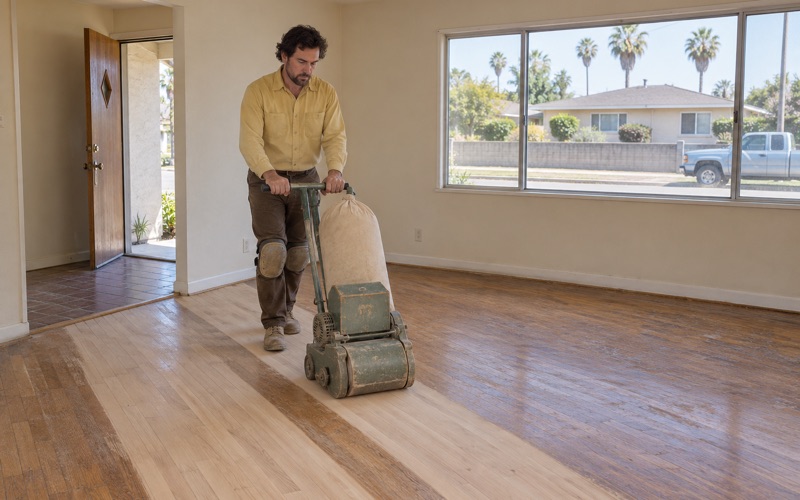
Most Signal Hill jobs we see happen inside a finished house: a refinish between tenants, boards replaced after a leak, or carpet pulled up to find out what is underneath. The craft is the same one we practice anywhere in the county, but the order we work in is what keeps a job from turning into a callback a month later.
Opening Up What Is Under the Carpet
When carpet comes up, we lift the pad, pull every flooring staple and the carpet tack strip, scrape off carpet pad adhesive, and fill the holes before a drum sander touches the wood. Skipping that step is how a floor ends up with dark pockmarks along every wall. If red oak or white oak is hiding under there, it deserves a clean start rather than a quick scuff.
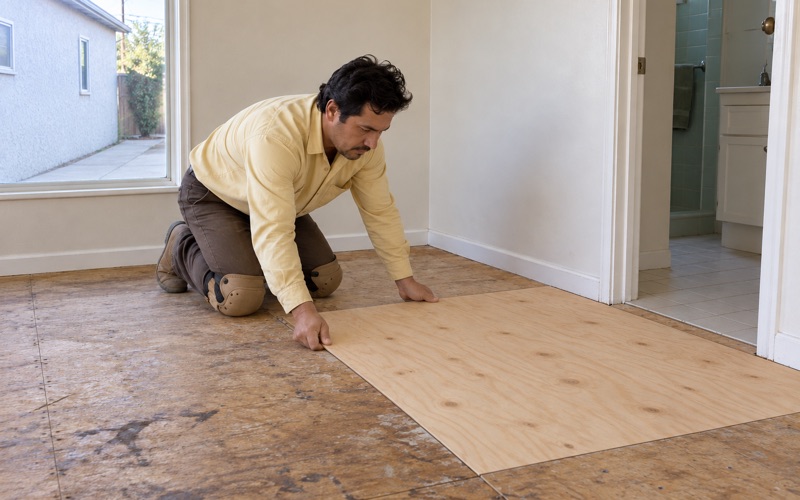
We also open and check the subfloor before pricing any new finish floor. Soft spots, water-swollen plywood sheathing and loose floor joists are far cheaper to find on day one than after new boards are down. If a board squeaks or a section of floor slopes, we look for the reason behind it instead of simply nailing over the problem and hoping it stays quiet.
Moisture, Old Tile and Lead
A wood moisture meter reading goes on paper before material is ordered, and any concrete gets tested too, with a calcium chloride moisture test or an ASTM F2170 in-situ relative humidity probe depending on the job. New boards sit for acclimation until their moisture content is close to the house’s. Cupping, crowning and board gaps are usually a moisture story told months too late.
Old 9x9 asbestos floor tile and black mastic under a floor get treated as a possible asbestos question before anything is scraped or sanded, which is the ground SCAQMD Rule 1403 covers. On any house built before 1978, we follow the EPA Renovation, Repair and Painting rule and lead-safe work practices, with plastic containment and a HEPA vacuum on every pass.
Finishes That Suit a Rental or a Family Home
For turnover work, we steer landlords toward a waterborne polyurethane or an oil-modified polyurethane that holds up between tenants, in a sheen level that hides everyday wear. Every product we apply meets the 275 g/L wood coatings VOC limit under SCAQMD Rule 1113. Stairs are priced per tread and riser rather than folded into a square-foot number, so the estimate reads the way the work is done.
When a tenant moves out, Civil Code 1950.5 calls for an itemized statement of deductions from a security deposit, and normal wear and tear is not a deductible cost. Our written estimates and invoices are itemized so they can serve that purpose cleanly. For a family staying put, the written cure schedule tells you when each room can be walked on, furnished and slept in.
Planning Floor Work in Signal Hill
Just under half the city’s occupied homes are rented, 2,260 of 4,545, so a lot of our scheduling here is built around a move-out date. We ask for that date first, then work backward through repairs, sanding, finish coats and cure time, so the unit is ready on the day the owner needs it and not a week later.
Water Damage and Insurance Claims
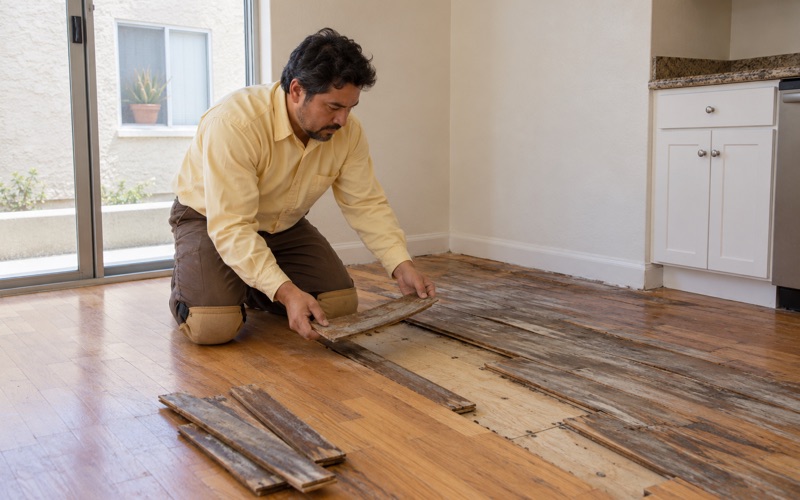
When a floor cups or stains after a leak, we trace the water to its source first, whether that is a supply line, a water heater or the unit upstairs. We document the damage with photos and moisture readings an insurance adjuster can use, and we do not start replacing boards until the source is fixed. A weave-in repair often saves the rest of the room.
Smoke residue and wildfire ash need their own handling. We clean the surface with a HEPA vacuum and inspect it before any new finish goes on, because a fresh coat can seal soot into the grain for good. That is also the stage where we decide whether a screen and recoat will do, or whether the floor needs a full sand through the grit sequence.
Choosing Boards for the Long Haul
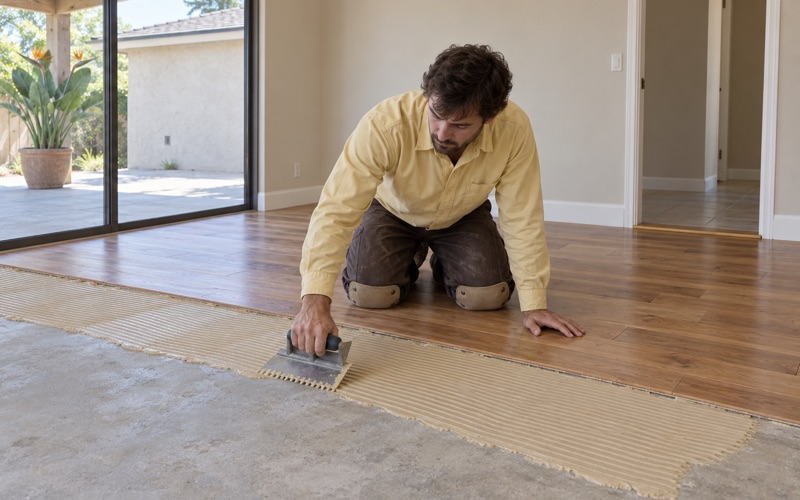
For new installs, we talk through Janka hardness rating, wear layer thickness and engineered core construction against solid hardwood, then match the method to the room: nail-down over a plywood subfloor, glue-down or floating over concrete with the right expansion gap. White oak, red oak, hickory and maple all have a place, and wide plank or herringbone patterns come down to taste and budget.
Questions to Settle Before We Start
Before a job goes on the calendar, we want to know three things: whether the work is only the floor or part of a remodel that touches other systems, whether anyone will be living in the house during the job, and whether there is a disclosure or covenant on the lot the owner wants explained. The first answer tells you whether to call Building Safety.
The second decides how we contain dust and how we write the cure schedule. The third we can point in the right direction without pretending to settle it, since wells and their records belong to the city and CalGEM. Once those are answered, the estimate you get is itemized, dated and written in plain language you can hand to anyone.
- 20+ Years With Wood Floors
- Written, Itemized Estimates
- Low-VOC South Coast Finishes