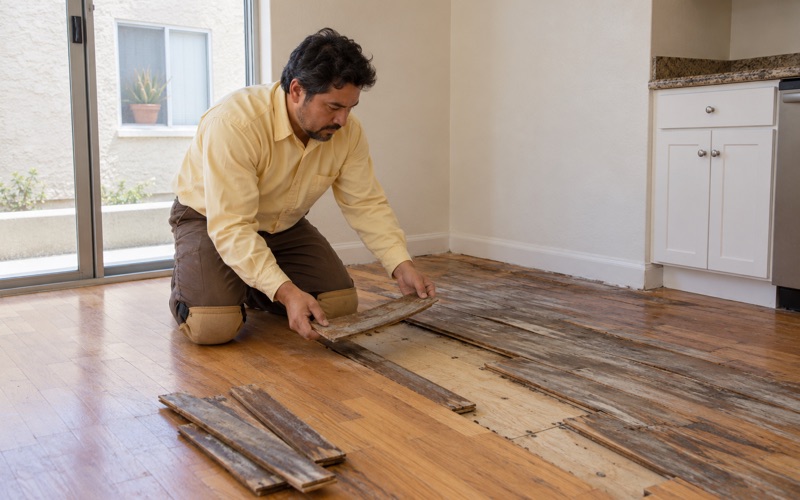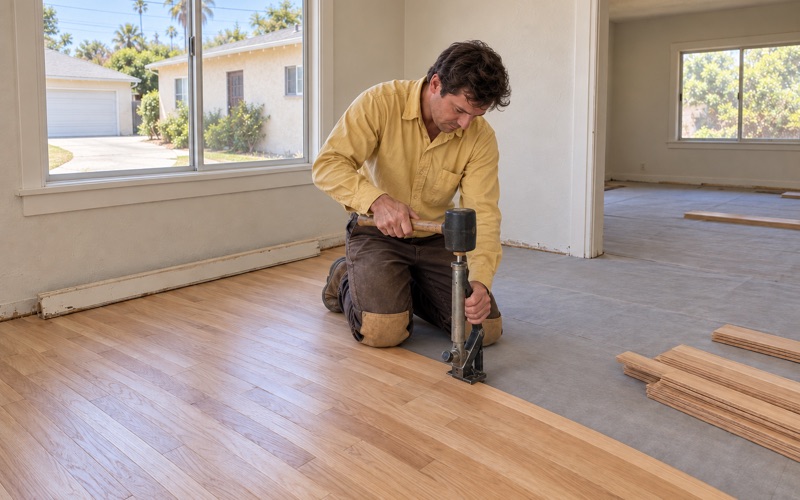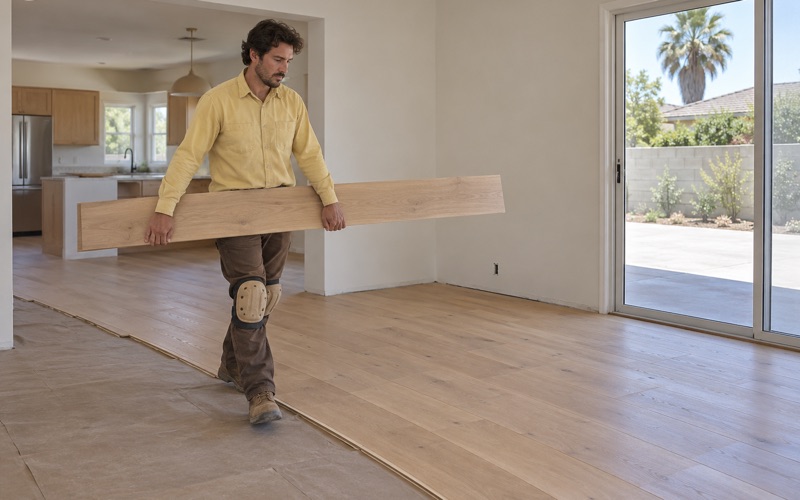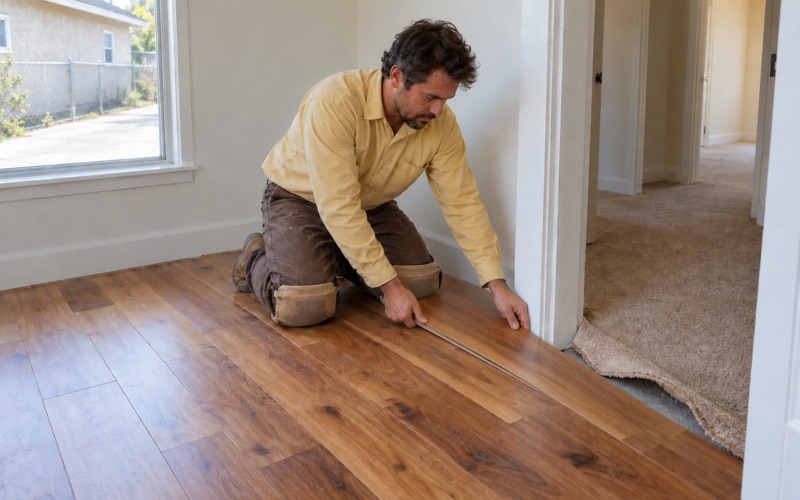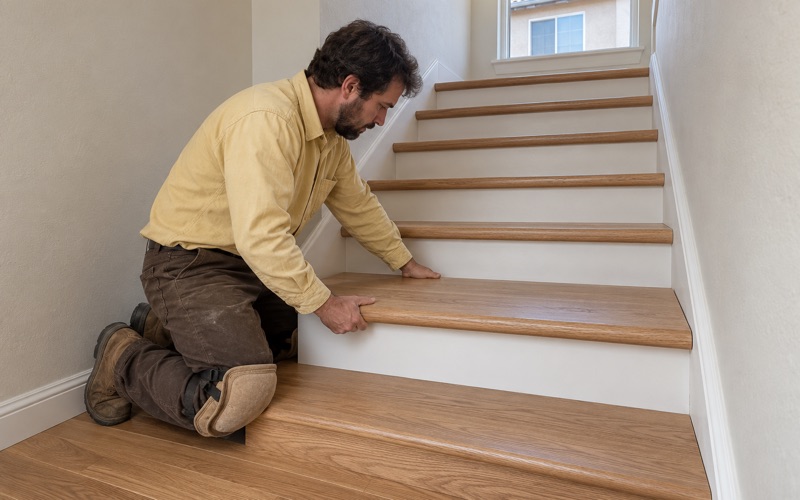
Hawthorne Wood Flooring has spent more than 20 years on wood-flooring in San Marino and across this part of Los Angeles County, and much of that work happens in houses older than anyone living in them. We refinish, repair and install hardwood with the age of the house in mind, because an older floor often has more left to give than its worn surface suggests.
Every job starts the same way: we open the floor before we price it. We lift a corner of carpet, check the subfloor for soft spots and swollen sheathing, and take moisture readings in the wood so the estimate reflects what is actually there. That estimate arrives written and itemized, so you can see where every dollar goes before any work begins.
There is a second question worth asking here before a sander comes through the door: whether a survey has already called your house historic. A good number of homes in this city carry that label without carrying any legal protection, and the choices you make about a floor now can keep or narrow your options later. This page explains what that means for the work.
What the 2020 Citywide Survey Counted
In October 2020, Architectural Resources Group completed a citywide historic resources survey for the City of San Marino. Field surveyors studied the city from its sidewalks and streets and recorded which properties appeared eligible for local landmark listing, many of which also appeared eligible for the National Register or the California Register.
286 Eligible Resources, 264 of Them Individual Buildings
The survey identified 286 resources that appear eligible as City of San Marino Historic Landmarks. Of those, 264 are individual buildings, and nine are non-building resources such as a public stair, the Mission Street Bridge and the Huntington Drive medians. Another 25 resources may be eligible but could not be seen well enough from the public right of way to evaluate.
That count matters because the city is almost entirely detached single-family houses: 4,377 of its 4,439 housing units are detached, about 98.6 percent. When the survey calls a building eligible, it is nearly always somebody’s home, and the floors inside it are the ones we are asked to sand, patch or replace.
Thirteen Districts Holding 1,890 Resources
Beyond the individual buildings, the survey found 13 eligible historic districts holding 1,890 contributing and non-contributing resources. Eight of them are groupings of single-family residences. At the small end sit the Shenandoah Road and Ardengrove Residential Historic Districts, at 30 buildings, while the Sherwood Road-San Marino Avenue Residential Historic District holds 494.
We do not map which street falls inside which district, and we would not guess at it for a customer. What the numbers tell us is scale. A single residential district here can hold hundreds of houses, so a homeowner calling about a cupped floor or a worn staircase has a real chance of living inside one.
The Houses the Districts Describe
The survey ties every residential district to the city’s main period of residential construction, the 1920s through the 1940s. Dozens of Spanish Colonial Revival, Tudor Revival and Mediterranean Revival homes are eligible individually, with hundreds more eligible as district contributors. The report also notes an unusual and possibly locally distinctive pairing of Monterey Revival and Minimal Traditional styles.
Housing data points the same way. Of the city’s 4,439 units, 1,811 were built in 1939 or earlier, about 40.8 percent, and 92.9 percent predate 1980. Houses tied to builders Phil Roulac and William Crowell appear among those eligible for their association, a sign of how much of the older stock the survey considered worth recording.
Looking for wood-flooring closer to La Cañada Flintridge? See Wood-Flooring Services in La Cañada Flintridge.
Eligible Is Not Designated
The most important fact about the survey is one the city states plainly: the survey produced no designations. Identifying a house as eligible is a research finding. Designating it is a separate process, subject to public notification, participation and review, and it has not happened for the great majority of the houses the survey counted.
Where the Ordinance Actually Reaches
San Marino adopted its Historic Preservation Ordinance, Municipal Code Chapter 23.18, on April 11, 2018, with the Planning Commission serving as the preservation commission. The ordinance governs designated historic landmarks, and the survey report lists nine formally designated landmarks in the city, among them the Hubble House, El Molino Viejo and the Michael White Adobe.
Properties already listed in the National Register or the California Register are treated as San Marino landmarks under the ordinance. An eligible house that sits on neither list, and has not gone through local designation, is an ordinary house in the eyes of that ordinance, however handsome its plaster, millwork or staircase may be.
Designation Starts With the Owner
Under the 2018 ordinance, designation requires the owner’s consent. That puts the decision with you, not with a surveyor, a neighbor or a contractor. You can pursue landmark status, decline it, or leave the question to a later owner, and nothing in the survey report forces your hand in either direction.
Because of that, we do not treat an eligible house as off-limits, and we will not tell you a district carries rules it does not carry. We treat it instead as a house whose owner may someday want the choice to stay open, and we plan the floor work so that choice is not quietly used up along the way.
What Still Applies to Every House
Eligibility aside, the city’s ordinary structure still applies. The Building Division of the Community Development Department at 2200 Huntington Drive handles building matters, the San Marino Design Review Committee looks at changes visible from the street, and the South Coast AQMD limits what finishes we can apply. Floors are interior work, but they sit inside that same framework.
Floors in a Survey-Listed House
Most of what a historic survey values is on the outside: rooflines, windows, setbacks, the way a house meets the street. The floors inside rarely appear in a survey report at all. That does not make them unimportant; it means the judgment about them falls to the owner and whoever they hire, so we try to make it carefully.
Finding Out What the Floor Is
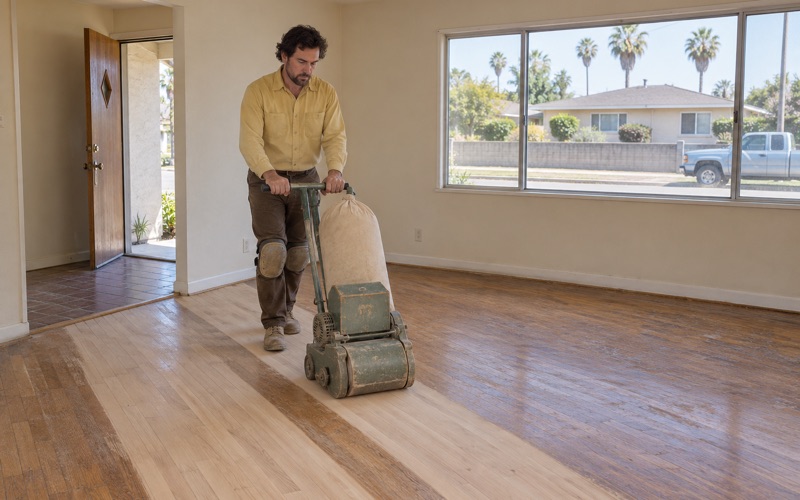
We never assume what species or pattern lies under carpet or vinyl in a house of this age; we look. Old carpet pad, staples and tack strip come up first, and every hole is filled before a drum sander or edger touches the boards. Once the floor is exposed, we can tell you what it is, how much wear layer remains and whether it can be refinished.
If the boards prove to be solid hardwood with enough thickness left, sanding and refinishing usually keeps far more of the house’s character than new material would. If they have been sanded too many times, cupped from past water or chewed by drywood termites, we show you the evidence, including any frass or kick-out holes, and price the options side by side.
Subfloor and Moisture Before Price
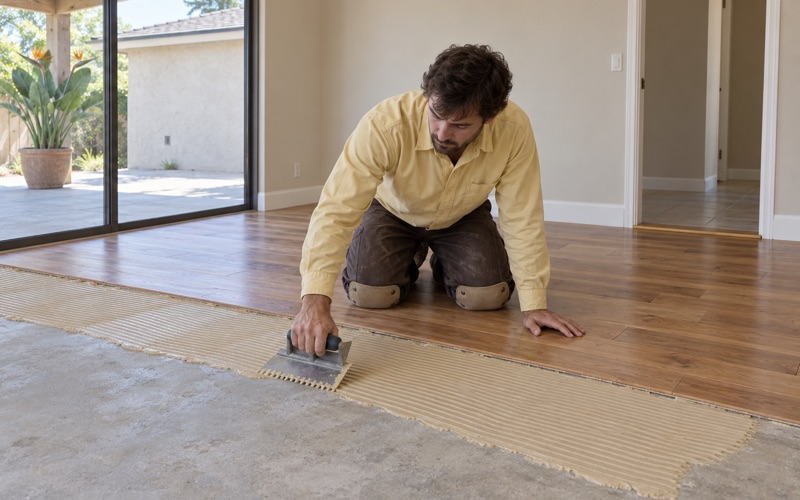
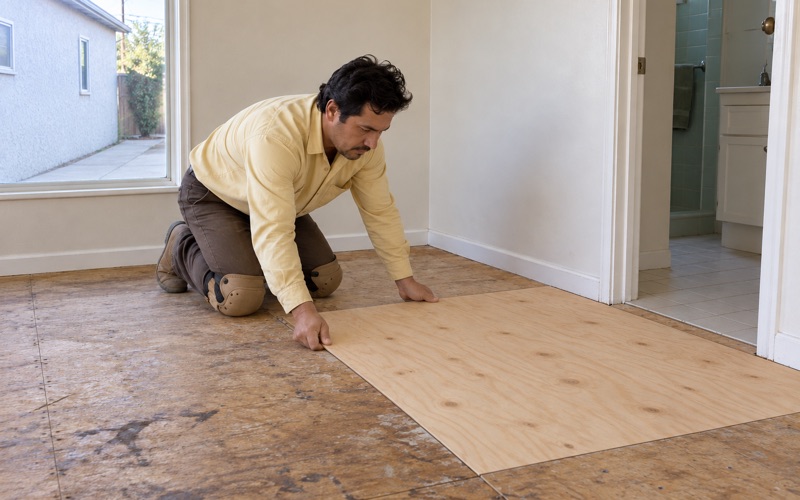
A floor laid decades ago can still hide a soft spot, a loose joist or the stain of an old leak. We open and check the subfloor before pricing any finish floor, and we read moisture content in the wood with a moisture meter, writing every reading down. Any concrete we find under an addition is tested with ASTM F2170 in-situ relative humidity probes.
San Marino sits in the National Weather Service’s Los Angeles County San Gabriel Valley forecast zone, and seasonal humidity swings move wood. New boards acclimate in the house before installation, following NWFA installation guidelines, so a repair or weave-in does not open gaps or crown against the older floor around it.
Lead, Asbestos and Air Rules
In a house built before 1978, we follow EPA Renovation, Repair and Painting rule practices, with dust containment and HEPA vacuums, because old painted baseboards and shoe molding can carry lead. Old 9x9 tile and black mastic found under a floor are treated as a possible asbestos question before anything is scraped or sanded.
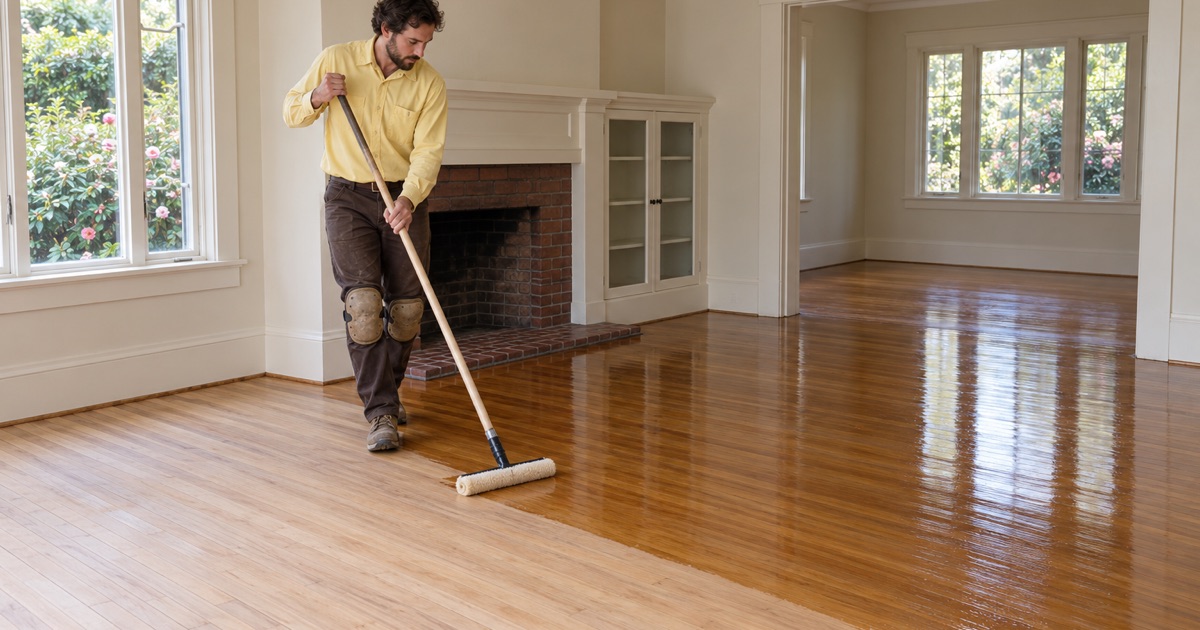
The finishes we apply are chosen from products legal in the South Coast air basin under SCAQMD Rule 1113 and its 275 g/L limit for wood coatings. That still leaves a real choice among waterborne polyurethane, oil-modified polyurethane and hardwax oil, each of which shifts the color and sheen of an older floor in its own way.
Keeping Options Open for a Future Designation
If you or a later owner ever pursues designation, the house will be judged on what survives. Floors are rarely the deciding factor, but a pattern of reversible, well-documented work reads very differently from a gut renovation. We approach floor jobs in survey-listed houses with that future reviewer in mind, even though nothing requires it of us.
Repair Before Replacement
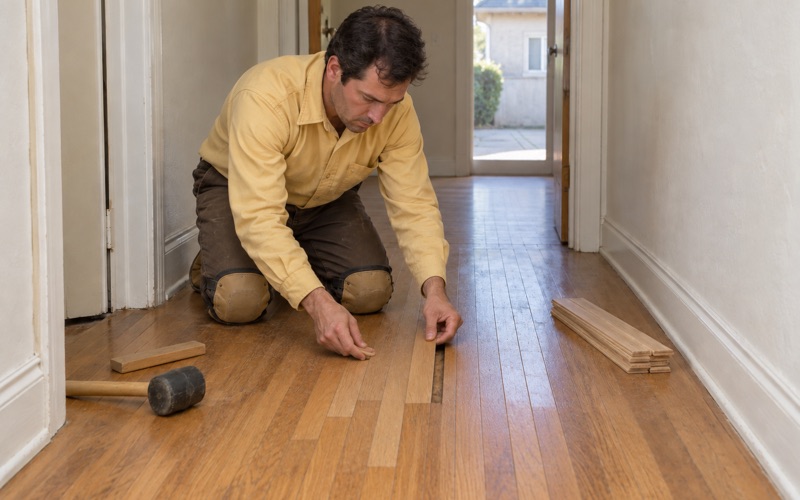
Where one section of floor is damaged, we favor board replacement and weave-in repair using matching species and width over tearing out a whole room. Stair treads, risers and nosings are priced per tread and riser, so you can restore a worn staircase piece by piece rather than accept a single square-foot number for it.
When replacement really is the better answer, we can save sound boards for patches elsewhere in the house, and we try to keep reducer strips and T-molding at the thresholds where transitions already exist. The aim is a floor that still reads as belonging to the house, whichever species, stain or sheen level you settle on.
A Written Record of the Work
Every job leaves paper behind: an itemized estimate, an itemized invoice, moisture readings, and photographs of the subfloor and any damage we found. If water is involved, we trace it to its source and document it in a form an insurance adjuster can use. That same file helps any later evaluation see what was kept and what was changed.
Owners here tend to hold their houses: 3,237 of the city’s 3,910 occupied units, about 82.8 percent, are owner-occupied. The person deciding someday whether to seek landmark status may be you or your family, and a clear file on the floors spares them from guessing what happened under the carpet years earlier.
Living in the House While We Work
Many households stay home through a floor job, and we plan for that from the first day. We contain dust, use a dustless sanding system where the floor allows it, and hand you a written cure schedule showing when each room can be walked on, furnished and slept in again, so nobody is left guessing.
If your house appeared in the 2020 survey, or you suspect it might have, tell us when you call. We will look at the floor with that in mind, explain which choices are easy to undo and which are not, and put our recommendation in writing before any sanding starts.
- 20+ Years With Wood Floors
- Written, Itemized Estimates
- Low-VOC South Coast Finishes