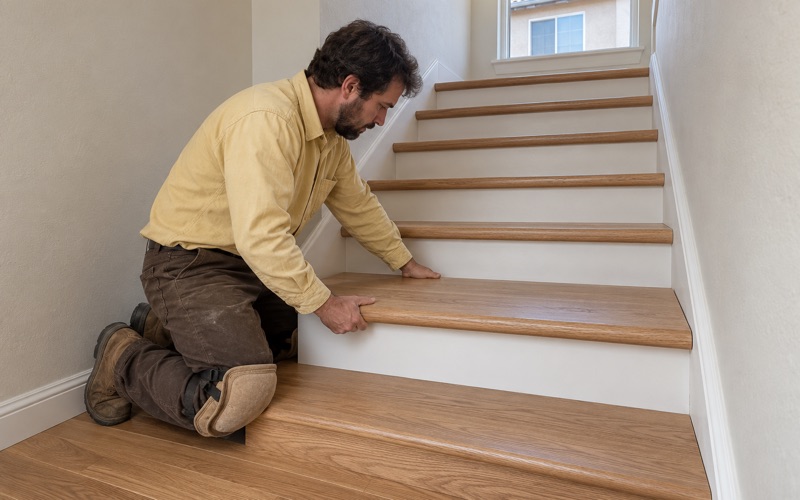
Hawthorne Wood Flooring brings more than 20 years of work to wood-flooring in Redondo Beach, and the jobs that ask the most of us here are the ones where a floor is shared. In a condo or a stacked townhome, the surface you walk on is also part of the ceiling over someone else’s living room, and that changes the job before any board is chosen.
So we start with paperwork rather than samples. Before we price a replacement in an attached home, we ask for the building’s declaration and read what it says about floor coverings, then we open the existing floor and check the subfloor underneath. Only after both are understood do we talk species, width and finish, because a beautiful floor that breaks a building rule is not a finished job.
The same approach holds for detached houses, rentals and refinishing work across the city. We measure moisture in the wood and in any concrete before ordering material, write the readings down, and hand over an itemized estimate that shows every line. What follows explains how the city’s own code treats floor coverings in condominiums and what that means for your project.
What Redondo Beach’s Condominium Code Says About Floor Coverings
Sound between stacked units is usually thought of as a building code matter, but Redondo Beach also addresses it in its own zoning code. Section 10-2.1608 of the Redondo Beach Municipal Code, the condominium section of Title 10, Chapter 2, sets sound transmission standards for the floor/ceiling assemblies that separate one unit from another, and it speaks to floor coverings by name.
Floor Coverings Counted as Part of the Assembly
The section allows a floor covering to be counted toward the impact rating an assembly has to meet. Once it is counted, though, the covering is treated as a permanent part of that assembly. It may only be replaced by another floor covering that provides the same or a greater degree of impact insulation than the one it replaces.
In plain terms, the carpet and pad in some Redondo units are not simple decoration. They may be doing acoustic work the building relied on when it was approved, and pulling them up for a hard surface can undo that work unless whatever goes down in their place performs at least as well against footfall noise.
What the Declaration Has to Say
The code also puts a duty on the condominium declaration. The impact rating for every separating floor/ceiling assembly has to be described there, and where floor coverings are what achieve the minimum, the declaration must state that those coverings shall not be removed for any purpose except cleaning or replacement, and that any replacement must match or exceed the original impact insulation.
That is why the declaration is the first document we ask to see. It is where your building records which floors carry that obligation, and it is written for owners rather than engineers. We read it not to second-guess anyone, but because the city requires this language to be there and your floor plan has to answer to it.
Laboratory Ratings, Not Field Tests
One detail in the section is easy to miss. The sound ratings it relies on are based on laboratory measurements of an assembly and are not subjected to field testing. The figure attached to a product comes from a lab setup, so the choices that matter in your unit are the ones that keep the real installation as close as possible to the build that was tested.
Looking for wood-flooring closer to View Park-Windsor Hills? See View Park-Windsor Hills Wood-Flooring.
Read the Declaration Before the Carpet Comes Up
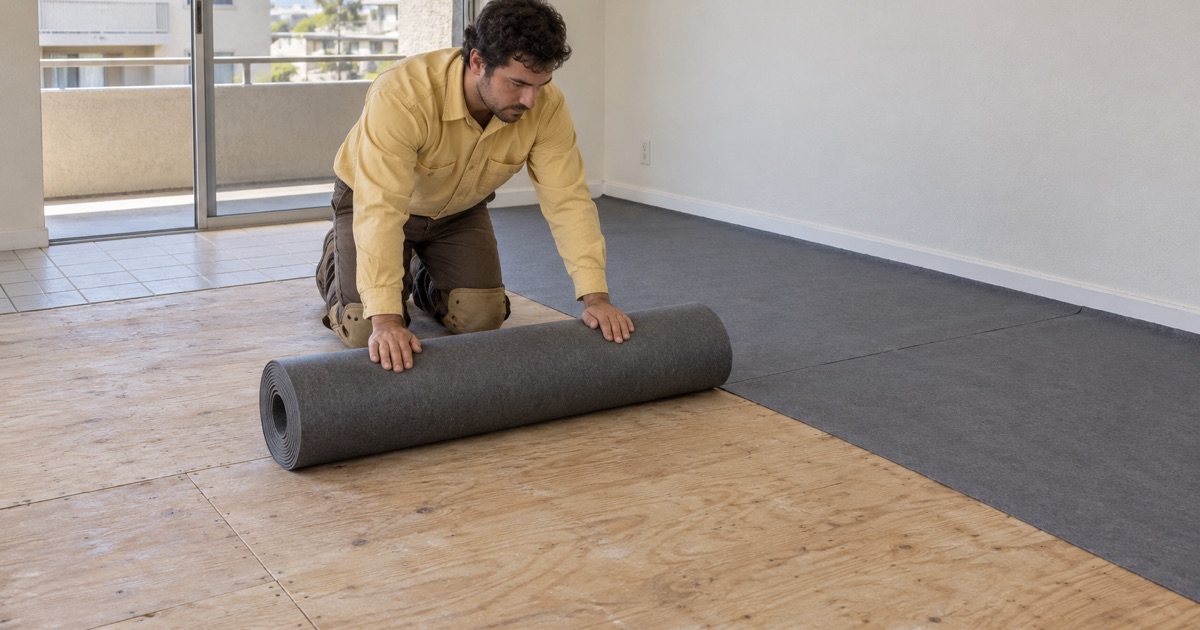
A carpet-to-hardwood swap is the exact case the condominium section anticipates. Carpet over pad is soft and absorbs impact, while wood is harder and passes more of a dropped heel or a dragged chair leg into the structure below. Swapping one for the other without a plan is how a quiet building becomes a noisy one.
What We Look For in the Document
We read the declaration for three things: whether it describes the impact rating of the floor/ceiling assemblies, whether it says floor coverings were used to reach that rating, and whether it names what a replacement covering must provide. If that language is there, the replacement plan is built around it from the first conversation, not patched on at the end.
If the declaration is silent or hard to follow, we say so in writing and suggest the owner ask the building’s managing agent for any supporting documents before we schedule work. We do not guess at what an old document meant, and we do not tell a client a floor is fine when the paper trail says otherwise.
Lifting the Carpet the Right Way
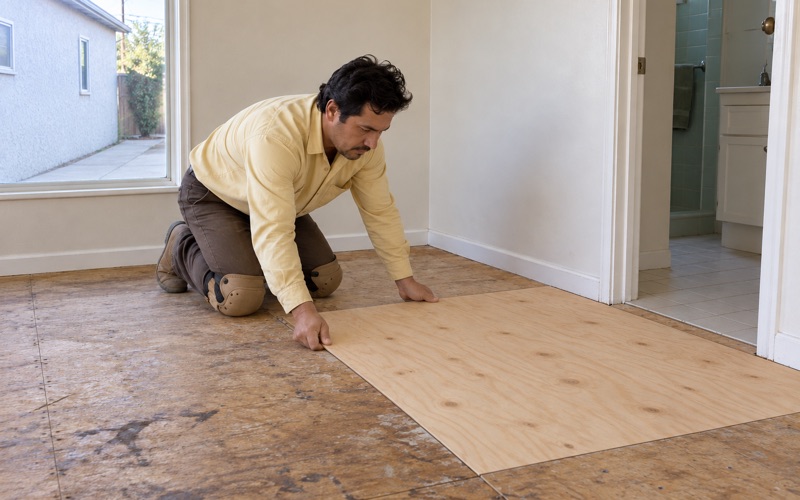
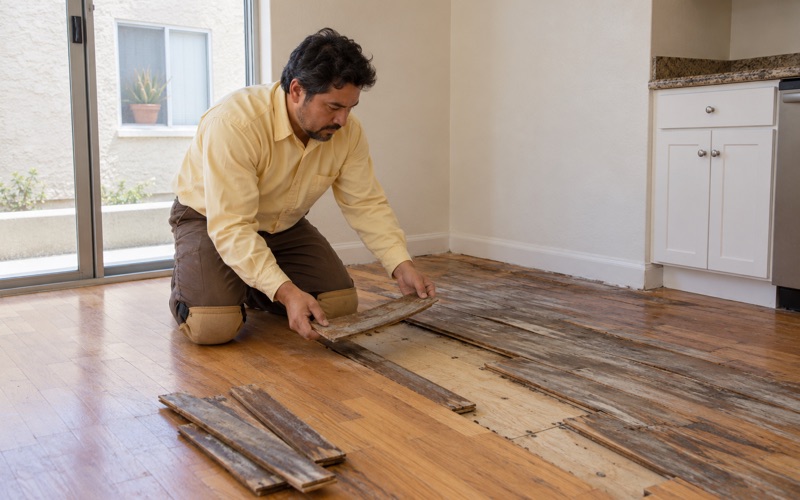
Once the plan is settled, the tear-out is careful work. We lift the carpet, pad, staples and tack strip, fill the holes, and look at what was underneath. Depending on the building, that may be a concrete deck or a plywood subfloor, and either one gets checked, so soft spots or water-swollen sheathing are found before any finish floor is priced.
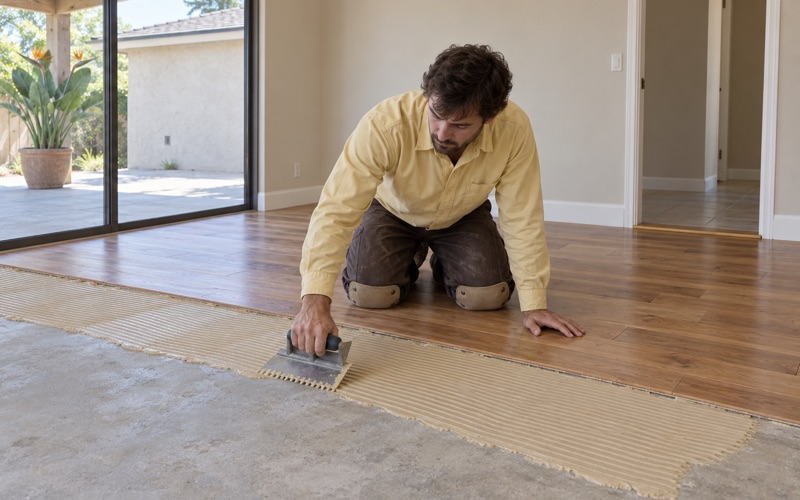
On concrete, we run an ASTM F2170 in-situ relative humidity test or a calcium chloride moisture test before recommending a glue-down or floating installation. On wood subfloors, a wood moisture meter tells us whether the new boards and the structure are close enough in moisture content for acclimation to do its job, and every reading goes into the written record.
Underlayment, the Neighbor Below and Redondo’s Attached Homes
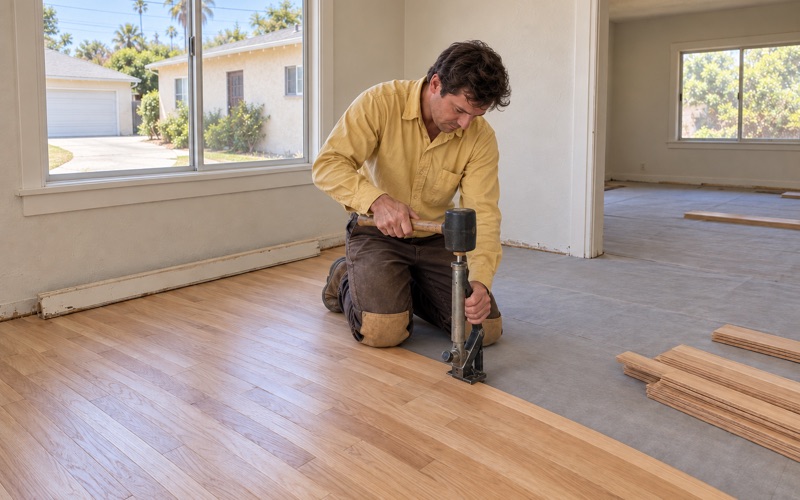
Underlayment is where a hard floor either respects the unit below or ignores it. An acoustic underlayment sits between the finish floor and the deck to soften impact before it reaches the structure, and on upstairs and condo installs we choose it with the neighbor below in mind rather than grabbing the cheapest roll that covers the room.
Choosing an Underlayment Against the Declaration
When a declaration ties replacement coverings to the impact insulation originally installed, the new floor and its underlayment have to be compared, as a combination, against what came out. We collect the manufacturer’s published acoustic data for the pairing we propose and share it with the owner, so the decision rests on documents rather than on our word.
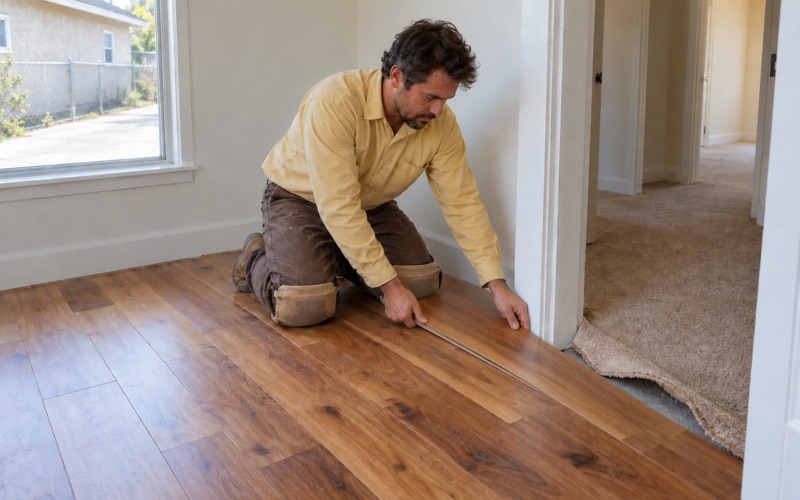
We will not tell you a particular product settles the question under the code; that comparison belongs to the owner and whoever the building relies on for it. What we control is installing to the tested build: the correct expansion gap, no rigid fasteners bridging the layer, and transitions and shoe molding kept from pinning the floor down.
How Many Owners This Touches
The group this affects is not small. According to the Census Bureau’s 2024 American Community Survey five-year estimates, 53.4 percent of Redondo Beach households own their homes, and 3,038 owner households live in one-unit attached homes, 20.1 percent of all owners. Another 2,157 owner households own in buildings of five or more units.
Age matters too. The 1970s are the city’s largest building decade, with 25.2 percent of housing units, which means a large share of townhomes and condos have had decades to collect earlier floor replacements. Each one may have changed what sits under the carpet, so we open a test area before assuming anything about the build-up.
Lead and Asbestos in Older Units
Older units also raise lead and asbestos questions. For homes built before 1978 we follow lead-safe work practices under the EPA Renovation, Repair and Painting rule. Any old 9x9 tile or black mastic found under carpet is treated as a possible asbestos question under SCAQMD Rule 1403, with an asbestos survey before anything is scraped, sanded or bagged.
Refinishing Versus Replacing in a Shared Building
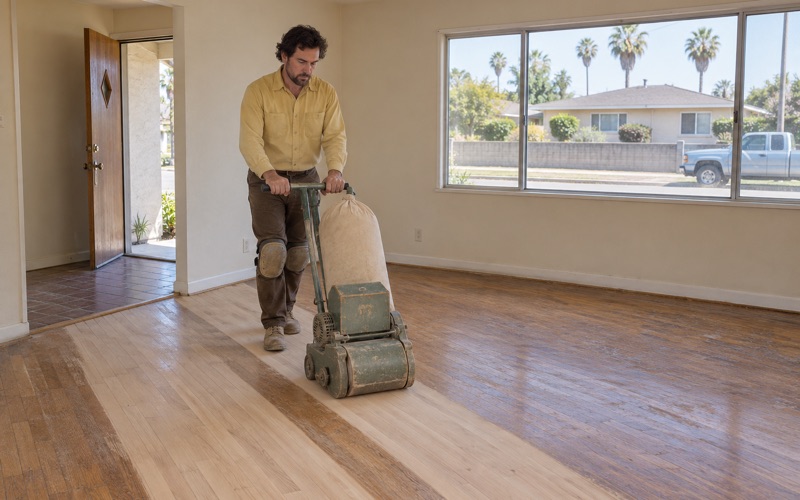
Not every Redondo condo needs new boards. Where a unit already has hardwood, refinishing leaves the existing floor covering in place, which sidesteps the replacement question entirely. A screen and recoat, or a full sanding with a drum sander, edger and grit sequence matched to the wear layer thickness, restores the surface without swapping out what the building counts on.
Dust, Finish and Working Hours
In a shared building, dust and odor travel. We run a dustless sanding system with HEPA vacuum cleanup and choose finishes legal in the South Coast air basin, where SCAQMD Rule 1113 sets the wood-coating limit at 275 g/L. A waterborne polyurethane is usually our first suggestion in stacked units because it dries quickly and carries less odor into the hallway.
We also keep to the city’s construction hours under Redondo Beach Municipal Code Section 9-1.12: 7 a.m. to 6 p.m. on weekdays and 9 a.m. to 5 p.m. on Saturdays, with no work on Sundays or major holidays. Sanding is loud, and the people who share your ceiling or wall deserve to know when it starts and stops.
When Replacement Is the Right Call
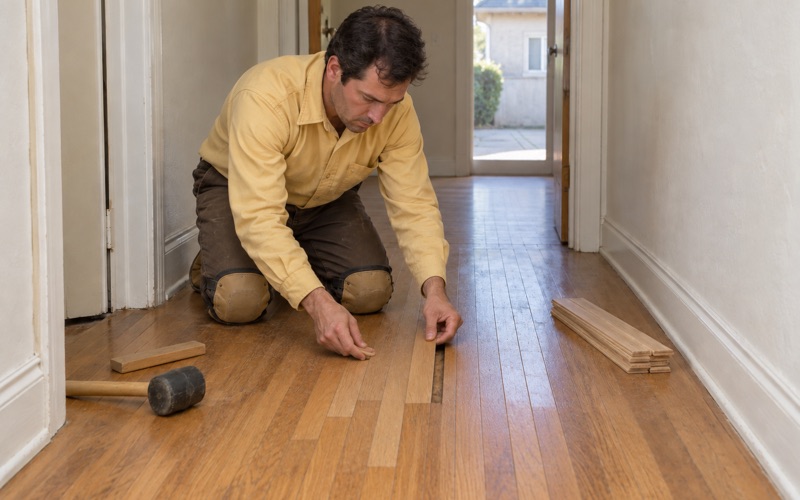
Replacement makes sense when boards are cupped past what sanding can recover, the wear layer is gone, or water from a unit upstairs has swollen the subfloor. In that last case we trace the leak to its source and document it with photos and moisture readings an adjuster can use, then plan the new floor and underlayment against the declaration like any other swap.
Owners sometimes ask whether a city program can help. Redondo Beach’s Mobility Access/Emergency Repair Program offers low-income and disabled homeowners a grant of up to $5,000, but its emergency repairs are restricted to electrical, plumbing and heating issues and water heater replacement, not floors. Our itemized written estimate keeps the budget clear from the first visit.
Rented Condos and Turnovers
Owners who rent out a Redondo condo or townhome face the same declaration language at every turnover. We schedule to the move-in date the owner gives us, finish floors to hold up between tenants, and write invoices a landlord or tenant can use for the itemized statement of deductions that Civil Code 1950.5 requires at move-out.
- 20+ Years With Wood Floors
- Written, Itemized Estimates
- Low-VOC South Coast Finishes