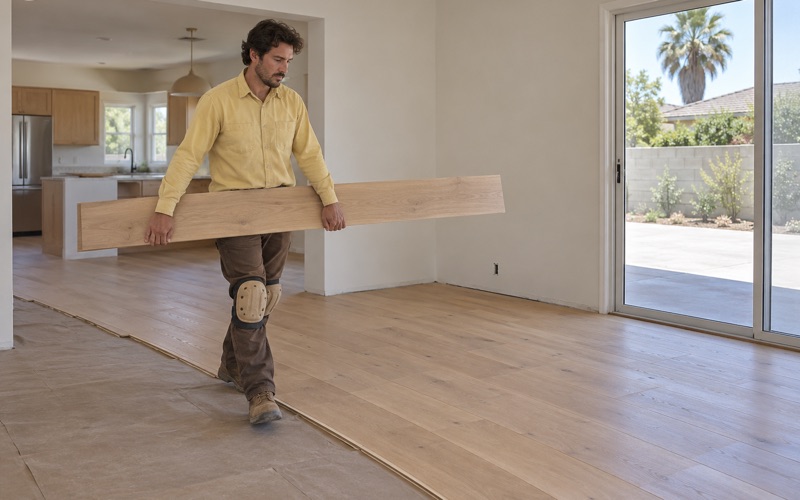
Hawthorne Wood Flooring has spent more than 20 years on wood flooring, and in Malibu that work now sits inside a recovery. Some houses here are going back up from bare lots and will need every floor installed new. Others came through the fire standing and need their existing floors cleaned, inspected and brought back before a household settles in again.
Both situations reward the same habit, which is measuring before promising. We open and check the subfloor before pricing any finish floor, we take moisture readings in the wood and in any concrete before material is ordered, and we write those readings down. On a rebuild, that record stays with the house and answers questions nobody thought to ask at framing.
What we do not do is guess. We will not tell you what a fire did to a floor we have not looked at, and we will not bury a staircase inside a square-foot number. Each estimate is written and itemized, so an owner, a builder or a tenant can see exactly what is being paid for and why it costs what it does.
Malibu’s Rebuild, by the City’s Own Count
What the April 2025 Report Counted
In April 2025 the City of Malibu released an economic impact report on the Palisades Fire, prepared by HdL ECONSolutions. It counts 531 single-family homes and 55 multi-family properties damaged or destroyed, along with 34 partially improved vacant parcels and 9 commercial parcels. It also records the displacement of approximately 1,400 residents and the destruction of 62 permitted short-term rental units.
Those figures describe the scale of the floor work ahead rather than any single job. Every one of those houses and apartment buildings that returns will need finish floors, stairs and transitions again. Wikipedia records that almost all of the beachfront homes in the east of the city were destroyed, which places much of that coming work along the coast.
A City of Owners Rebuilding Their Own Houses
Census figures put 75.4 percent of Malibu’s occupied homes in owner hands, and 3,977 of the city’s 6,434 housing units are one-unit detached houses. In practice, most rebuild decisions about floors here are being made by the people who will live on them, not by a developer choosing a finish from a spec sheet.
Owners tend to care about details a production build would skip: how a wide plank lines up with a doorway, whether the stair nosing matches the treads, which sheen hides the grit tracked in from outside. We plan and price at that level, because that is where an owner’s satisfaction is won or lost, long after the final inspection is signed.
Where the Recovery Stood in September 2026
By mid-September 2026 the city had marked its 100th Palisades rebuild permit and issued its first certificate of occupancy for a rebuilt home. The first houses are reaching the stage where interiors go in, while many more are still in plans or framing. That spread matters for flooring, because each house’s own schedule decides when its wood should arrive on site.
Looking for wood-flooring closer to Agoura Hills? See Wood-Flooring Services in Agoura Hills.
New Floors for a Rebuilt House
Moisture Readings Before Any Material Is Ordered
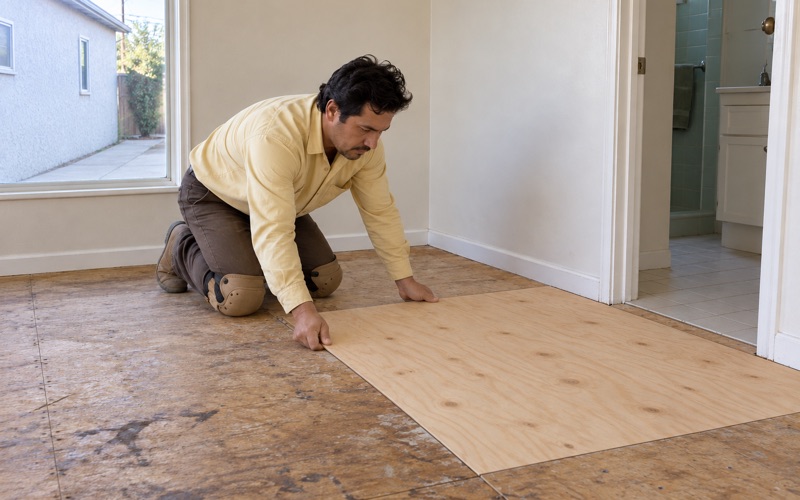
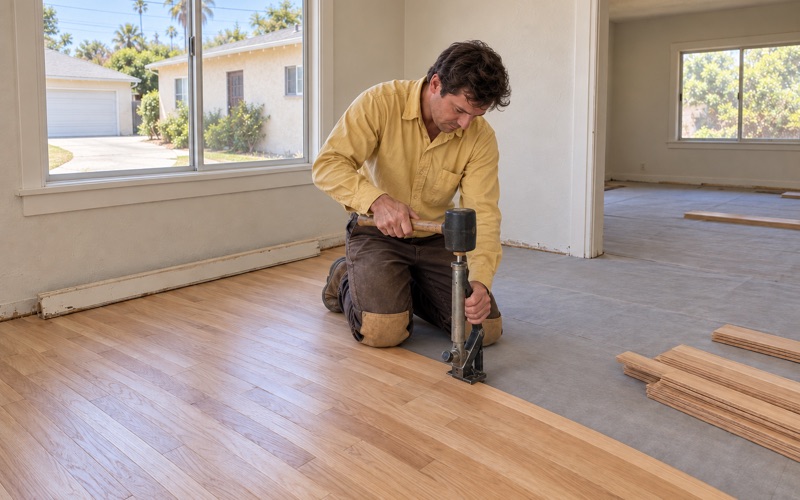
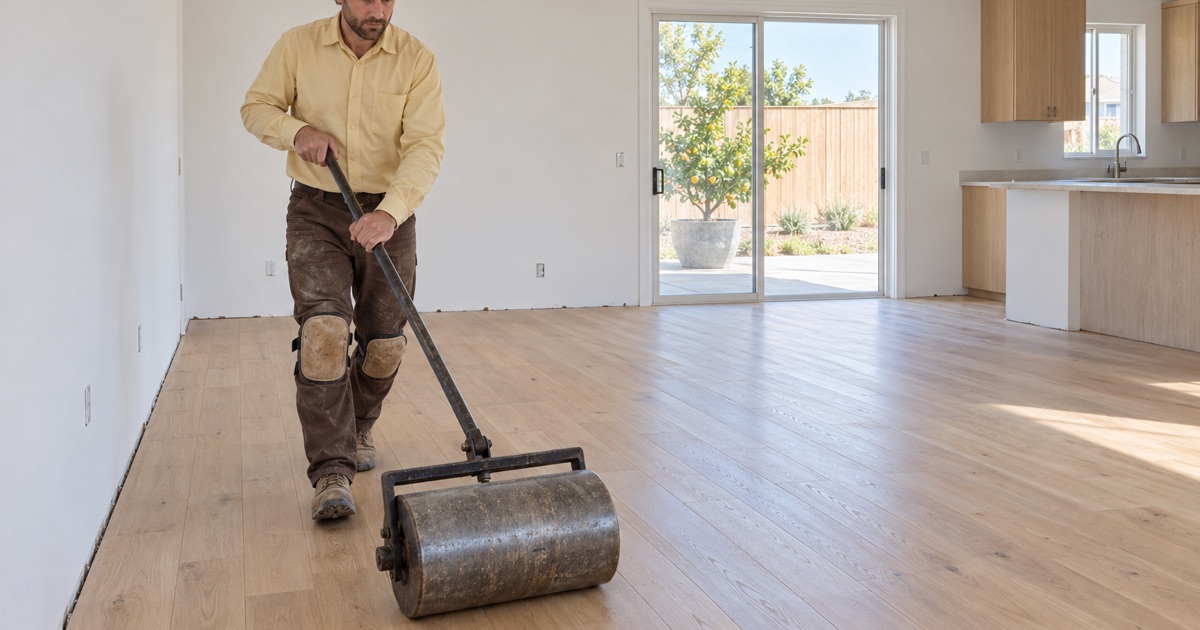
A newly built house holds water from its own construction: fresh concrete, wet-applied finishes, drywall compound and framing that has sat open to the weather. We measure moisture content in the flooring with a wood moisture meter and test any concrete with an ASTM F2170 in-situ relative humidity test or a calcium chloride moisture test, depending on the assembly. The readings are written down before a single box is ordered.
Acclimation follows the readings, not the calendar. The NWFA installation guidelines tie installation to the difference between the wood and the subfloor, and we hold material until that gap is inside tolerance. Installing into a wet new house is how cupping, crowning and board gaps show up in the first season, once the building finally dries out around the floor.
Choosing Species and Construction
Owners rebuilding often start from what they lost, then adjust. White oak remains a common choice for its grain and the way it takes stain, while hickory and maple bring a higher Janka hardness rating for households with dogs or heavy foot traffic. Walnut is softer and darker, and it suits rooms where wear is light and the look matters most.
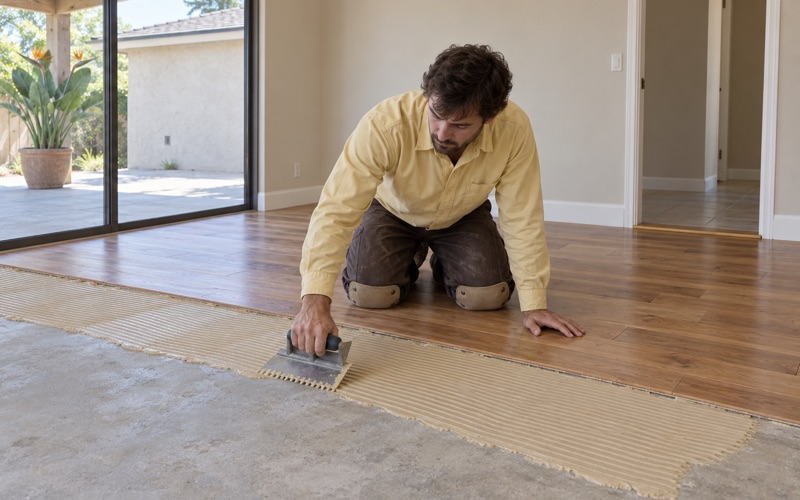
Construction is its own decision. Solid planks can be sanded many times, while an engineered core construction resists seasonal movement and can go down as a glue-down installation over concrete. We talk through wear layer thickness, because it decides how many refinishes the floor can take, and we confirm engineered products carry CARB Phase 2 compliant labeling under TSCA Title VI before delivery.
Stairs, Transitions and Patterns
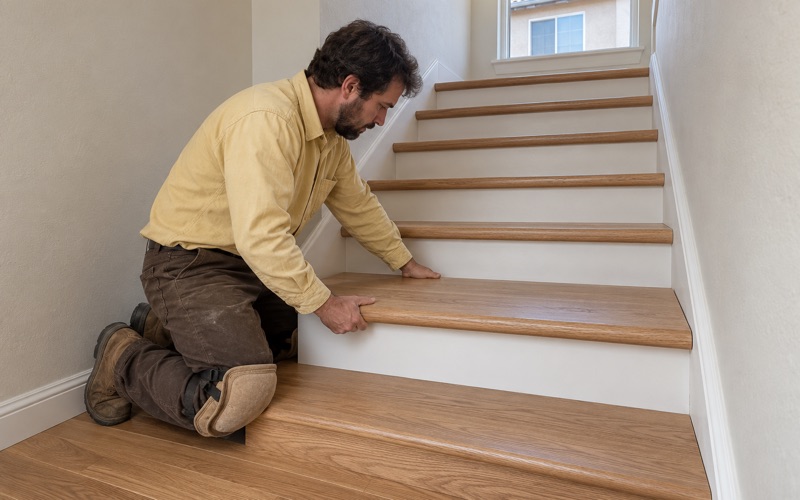
Rebuilt houses often carry more stairs than the first drawings suggest, and we price them per stair tread and stair riser rather than folding them into a square-foot figure. That keeps the estimate honest when one plan has three short runs and another has a single long flight. Stair nosing is matched to the field floor so each edge reads as one piece.
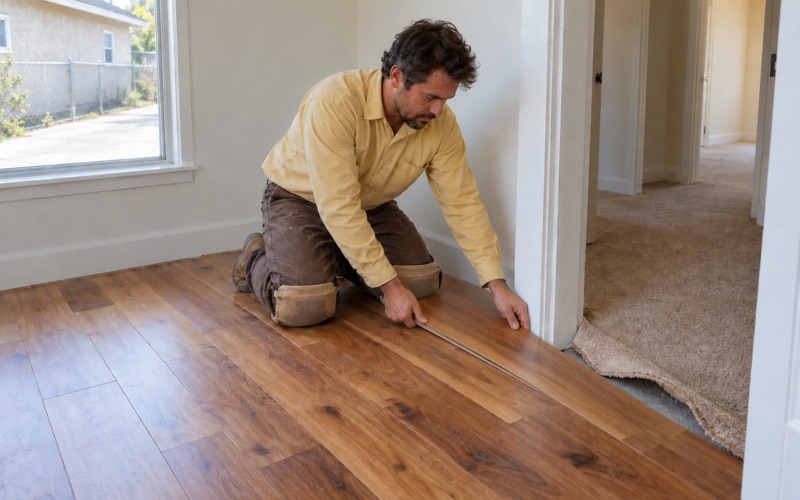
Pattern floors belong in the plan early. A herringbone pattern or chevron pattern needs layout lines set before cabinets and built-ins are fixed, and reducer strips and T-molding at doorways depend on the final heights of the tile and stone beside them. Settling those heights before finishes begin saves an awkward lip at the kitchen threshold later.
Floors in Homes That Came Through the Fire
Cleaning and Inspecting Before Any New Finish
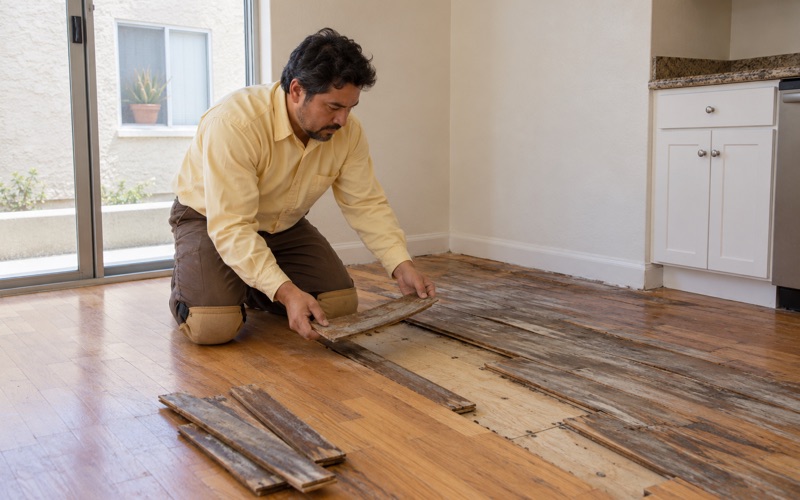
Not every house in the fire’s path was lost, and a house that stood carries its own questions. When a floor has been exposed to wildfire ash or smoke residue, we clean it first with a HEPA vacuum and careful hand wiping, then inspect the boards and the finish under strong light. Only after that do we recommend a screen and recoat, a full sanding or nothing at all.
The order matters because a fresh coat can seal soot into the grain. Once it is locked under new polyurethane, the only way out is sanding the floor back to bare wood. Cleaning and inspecting first costs far less than a floor sanded twice, and it leaves the owner with a written record of what the floor looked like before we touched it.
Older Houses and Lead-Safe Work
Malibu’s housing is older than its reputation suggests. Of the city’s housing units, 59.9 percent were built before 1980, and the 1970s are the largest single building decade at 26.1 percent of the stock. A standing house from that era may carry decades of finish layers, patches and earlier remodels beneath the floor you see today.
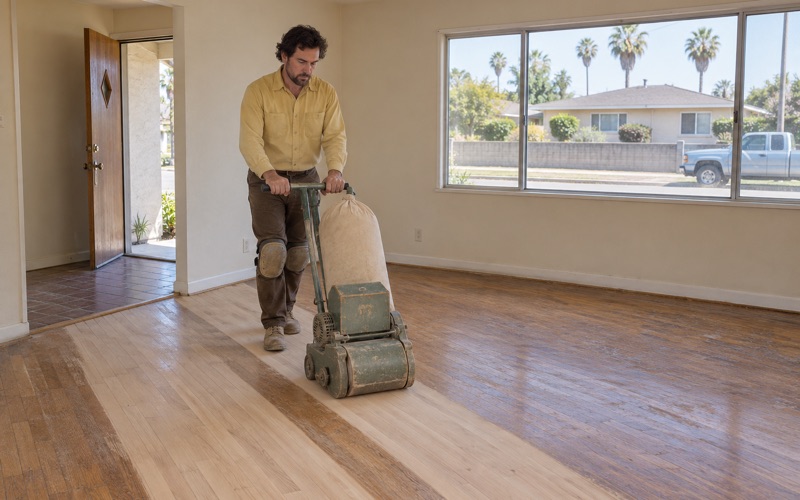
On any house built before 1978 we follow lead-safe work practices under the EPA Renovation, Repair and Painting rule, with dust containment around the work area and a dustless sanding system connected to the drum sander and edger. The goal is simple: the rooms you are still living in stay clean while the room we are working in gets sanded.
Carpet, Tile and What Lies Beneath
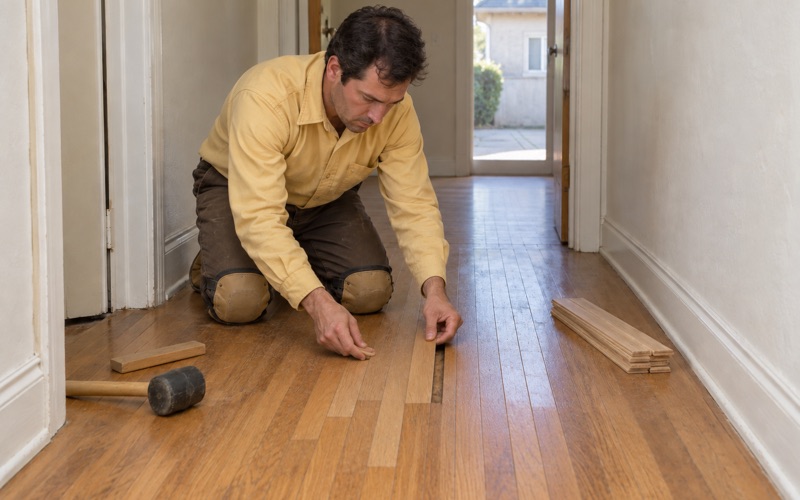
Many houses from those decades had carpet laid over wood at some point. When we pull it, we lift the old carpet pad, the flooring staples and the carpet tack strip, then fill the holes before sanding so the oak underneath refinishes clean. Where a board is too far gone, a weave-in repair or board replacement ties new wood into the old floor.
Some older floors hide 9x9 asbestos floor tile or black mastic under a later layer. We treat either as a possible asbestos question and stop before anything is sanded or scraped, so an asbestos survey can settle it. That pause is short compared with the problem of disturbing the material in a house where a family is living.
Planning Floor Work Around a Rebuild Permit
Where Flooring Falls in the Sequence
Finish flooring is one of the last trades in a rebuild, after the building is closed in, the drywall is finished and the major wet work has dried. We aim to arrive when the moisture readings say the house is ready, not simply when the schedule says floors are next. We coordinate with the builder so a date on paper never forces wood into a damp room.
Rebuild permits and certificates of occupancy are issued by the City of Malibu, and the builder or owner holds that relationship. We fit our work into their schedule and supply what they need from us: written material specifications, dated moisture readings and a finish timeline showing when the floors will be ready for the final walk-through.
A Written Cure Schedule for Move-In
Families returning after a long displacement want a date they can plan around. We give each job a written cure schedule showing when a room can be walked on in socks, when furniture can return and when rugs can go down. That lets a household book movers and deliveries around the floor instead of scuffing a finish that has not fully hardened.
For owners rebuilding a duplex or small multi-family property, the same schedule works as a turnover date. We finish rental floors to hold up between tenants, and our itemized estimates and invoices give a landlord the paperwork California deposit law expects when repair costs are deducted at move-out.
Finishes Legal in the South Coast Air Basin
Malibu falls within the South Coast Air Quality Management District, where SCAQMD Rule 1113 sets the 275 g/L VOC limit for wood coatings. We choose finishes that meet it, whether a waterborne polyurethane, an oil-modified polyurethane or a hardwax oil finish. Each wears differently and ages to a different color, so we show samples on your own boards first.
Sheen level is the last decision and one of the most visible. A matte or satin sheen hides the fine scratches that daily living leaves behind, while a higher gloss shows every one. For a house near the beach, where sand comes in on every pair of shoes, we usually steer owners toward the lower sheens.
- 20+ Years With Wood Floors
- Written, Itemized Estimates
- Low-VOC South Coast Finishes