Hawthorne Wood Flooring brings more than 20 years of wood flooring in Los Alamitos and across our service area to the question owners ask us most after a leak or a storm: can this floor be saved? Sometimes it can be dried, flattened and refinished. Sometimes the boards or the sheathing under them have to come out, and the honest answer is the useful one.
We sand, refinish, repair and install solid and engineered floors in single-family houses, condos and small rental buildings. Before we price any finish floor, we open and check the subfloor, measure moisture in the wood and in any concrete, and write the readings down. That habit matters most on a floor that has already been wet once.
This page is about water and wood in one particular setting. It covers what the city’s own planning documents say about drainage and flooding, what a flood zone label can and cannot tell you, how we judge a floor after water reaches it, and what to line up before work starts in your home or rental.
Wood Floors in a City Drained by Concrete Channels
Los Alamitos was incorporated in March 1960, and a significant part of the city is occupied by Joint Forces Training Base – Los Alamitos. The rest is homes and small apartment buildings on land the city’s Housing Element describes as near build-out. What most owners never see is the drainage running through and around it all, and that drainage shapes how we talk about water damage here.
What the Housing Element Says About Flooding
The city’s adopted 2021-2029 Housing Element states that the Orange County Flood Control District maintains storm drainage and flood control in Los Alamitos. It also says most flood-control facilities within the city currently provide protection for a 25-year storm. That is a design level for the channels and drains, not a statement about any single house or any single floor.
A 25-year storm is a rainfall event expected, on average, about once in 25 years, which works out to roughly a one-in-25 chance in any given year. Over the working life of a wood floor, that is not a remote possibility. We mention it so owners understand why we ask about past rain events when we find old water staining near exterior doors.
Coyote Creek, Carbon Creek and the San Gabriel River
The same element names three natural surface water bodies in and beside the city: Coyote Creek, Carbon Creek and the San Gabriel River. The two creeks are concrete-lined and intermittent, and they can be dry for part of the year. The concrete-lined San Gabriel River flows year-round in its lower end, so it never looks empty the way the creeks can.
The element says areas of potential flooding in and near the city are generally associated with Coyote Creek and Carbon Creek. A dry channel in August tells you nothing about how it runs in a heavy storm. When a homeowner calls about a stained or cupped floor after a big rain, we treat outside water as one possibility among several, never as the default explanation.
A Housing Stock Built Mostly Before 1980
Census figures show 70.5 percent of Los Alamitos housing units were built before 1980, with the largest share dating from the 1960s. Floors in homes of that age have often been through a leak, a remodel or two, and several layers of carpet. Water that reached them years ago can still show as dark board edges, loose nails or a soft spot underfoot.
Age also changes how we work. Houses built before 1978 get lead-safe work practices under the EPA Renovation, Repair and Painting rule, and old 9x9 tile or black mastic found under a floor is treated as a possible asbestos question before anything is sanded or scraped. Both steps add time, and we put that time in the estimate rather than surprising anyone halfway through.
Looking for wood-flooring closer to South El Monte? See South El Monte Wood-Flooring.
Zone Labels and What They Leave Out
Owners often tell us their flood zone before they tell us anything about the floor. It is a reasonable place to start, because the city participates in and promotes the National Flood Insurance Program and flood maps are easy to look up. But a zone label answers a different question from the one we are there to answer, which is what this floor needs.
What a Label Describes
A flood map zone describes the modeled chance of flooding across an area, based on how water moves in large storms. The Housing Element uses these labels for the housing sites it inventories, not for individual homes, and we do not tell anyone which zone their address falls in. That lookup belongs with the official map and, for coverage questions, with an insurance agent.
What a zone never records is the water that actually ruins most floors: a failed supply line, a slow toilet seal, a water heater, or a leak from the unit upstairs. None of those care what the map says. A home in any zone can have a floor that needs replacing, and a home in a higher-risk zone can have one that has never been wet.
Why We Measure Instead of Assuming
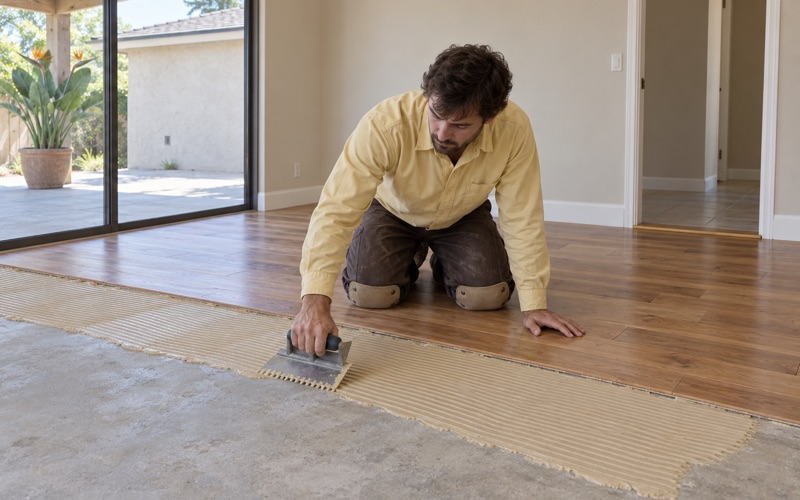
So we measure. A wood moisture meter gives readings board by board, and across a room those numbers show where water went and whether it is still there. Where a floor sits on concrete, we run an ASTM F2170 in-situ relative humidity test or a calcium chloride moisture test before recommending anything glued down or floated over it.
The readings go on paper with the date, the room and the exact spot. That written record helps whether the next step is drying, a repair or an insurance claim, and it gives the owner something to compare against if the floor moves again after a later storm or leak. A map label cannot do either of those jobs.
Flat Ground and Where Water Sits
The Housing Element notes that Los Alamitos has flat topography, which is why residents are not exposed to landslides, and that no known active faults lie within the city. For a floor, flat ground mostly means we look closely at thresholds, slider tracks and low corners, where water that got inside tends to sit rather than run off.
Judging a Floor After Water Gets In
When water has reached a wood floor, the order of work decides the outcome. Refinishing a floor that is still wet, or replacing boards over a leak that has not been fixed, just schedules the same failure again. We follow the same sequence on every water job, whatever the size of the room and whatever the source turns out to be.
Trace the Source First
We start by finding where the water came from and confirming it has stopped. In a condo or a stacked rental that is often a unit upstairs, with water running inside a wall or along framing before it shows. We follow the staining and the readings back to the source, and we photograph each step so nothing depends on memory later.
If the source is plumbing, a roof or a neighbor’s unit, we say so plainly and recommend who should fix it before we touch the floor. Our part begins once the water is off. That keeps our estimate honest, because a floor quote that ignores an active leak is not worth the paper it is written on.
Reading the Boards: Cupping, Crowning and Buckling
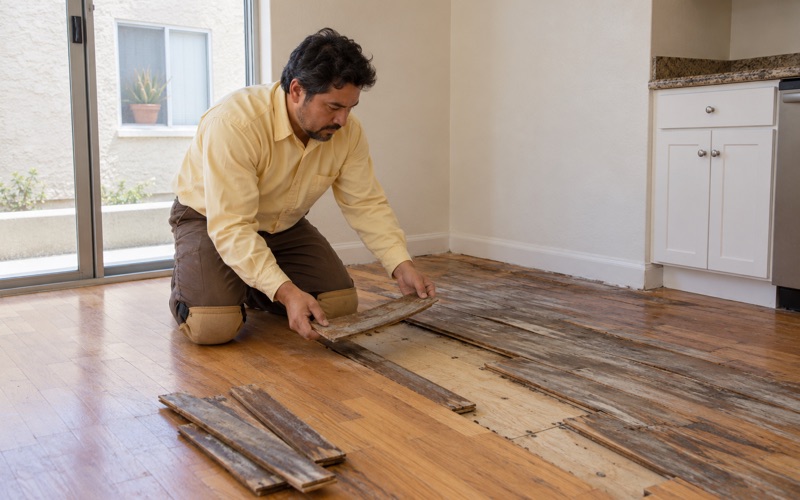
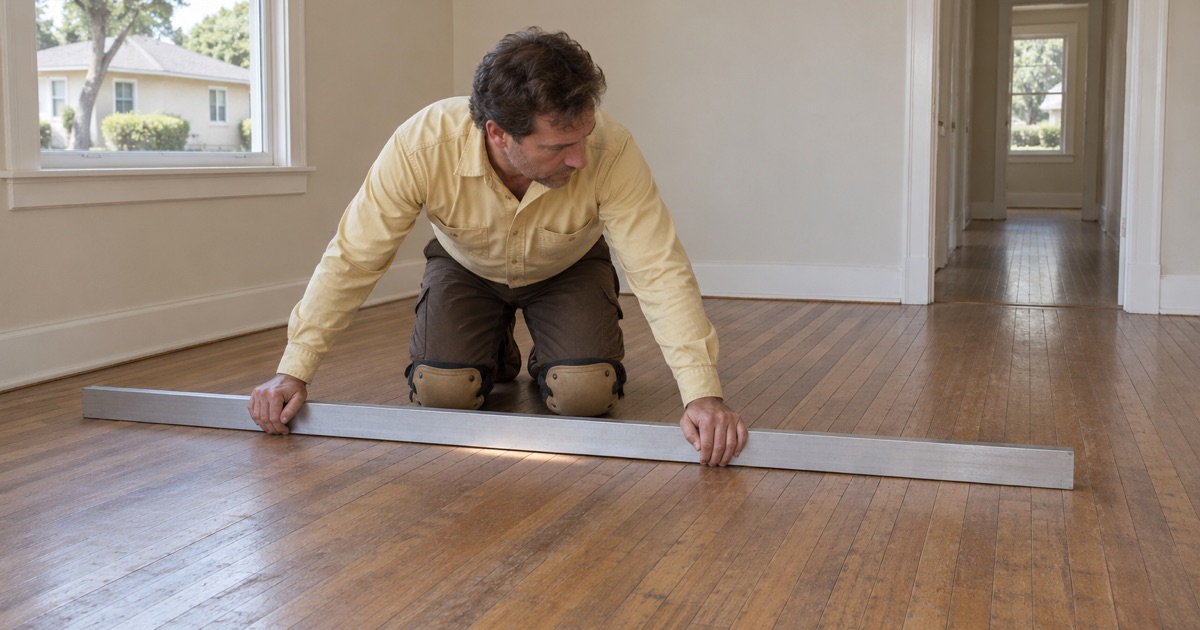
Wood takes on water and swells across the width of each board. Cupping, where the edges rise above the center, usually means moisture is still coming from underneath. Crowning, the reverse, often shows up when a cupped floor was sanded flat before it dried. Buckling, where boards lift off the subfloor, means the swelling simply ran out of room.
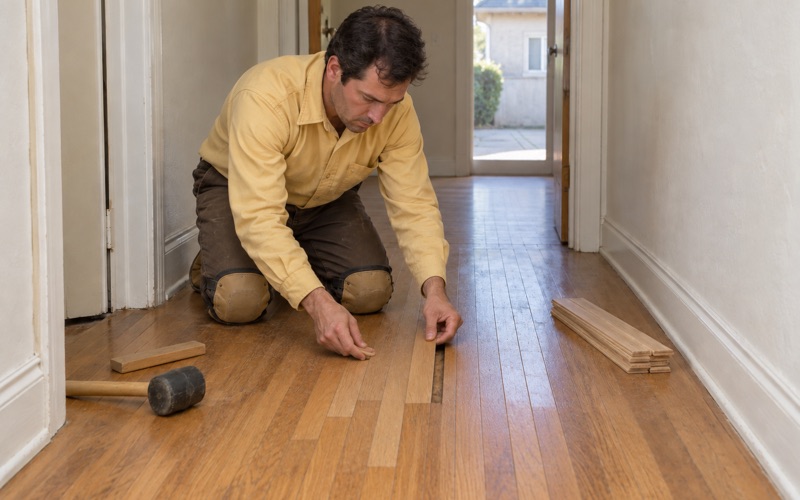
Each pattern points to a different answer. A mildly cupped floor can often flatten as it dries and then be sanded and refinished. Crowning usually means waiting and resanding. Buckled boards generally come out, and we cut in replacements with a weave-in repair so the new boards stagger with the old ones rather than leaving a straight seam across the room.
What Sits Under the Boards
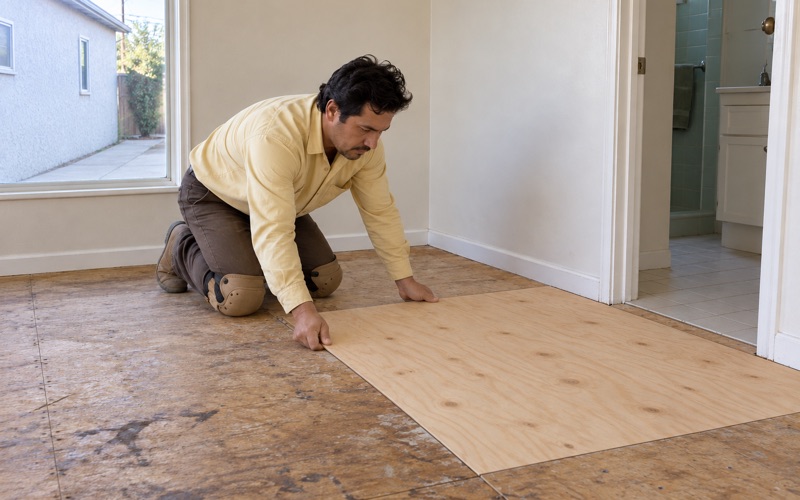
The finish floor is only half the question. We open the floor in the worst spot and check the plywood or plank subfloor for swelling, delamination and rot, and the framing for loose or stained members. Water-swollen sheathing and soft spots found now cost far less than a callback after a new floor has been nailed right over them.
Old floors hide their own trouble too. We lift carpet pad, staples and tack strip and fill the holes before sanding, and we look for termite frass or kick-out holes while the floor is open. On a water job that inspection often turns up earlier damage that the current leak simply made visible for the first time.
Documentation for the Claim
Many water jobs involve an insurance claim, and an adjuster needs more than a description. We provide dated photos of the source, the damage and the open subfloor, the moisture readings by location, and a written, itemized estimate that separates drying, repair and refinishing. We do not decide coverage, but we give the adjuster clean information to decide it with.
Planning Floor Work in Los Alamitos
Renters hold 57.6 percent of occupied homes in Los Alamitos, and many rentals sit in buildings of two to nine units, so a lot of our planning revolves around turnover dates and neighbors. Owner-occupied houses have their own rhythm. Either way, the details below are what we settle before the first sander comes off the truck.
Rentals Between Tenants
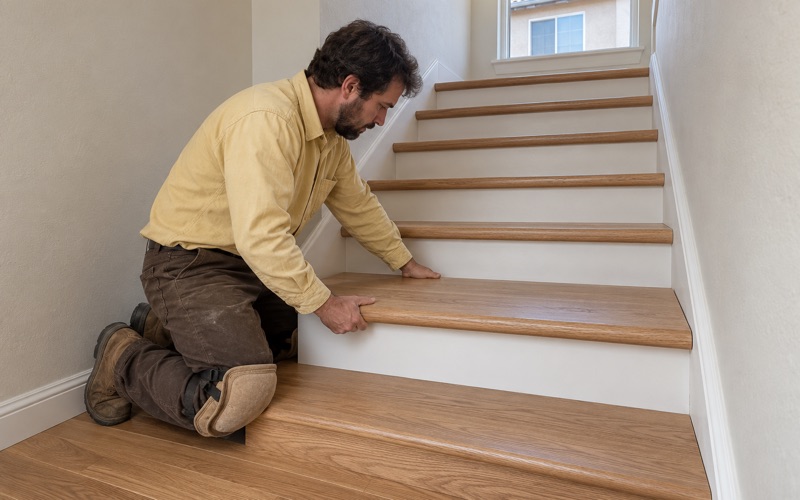
For a rented house, duplex or fourplex, we finish floors to hold up between tenants and schedule around the turnover date the owner gives us. Our invoices break out every line, so a landlord or tenant can use them at move-out when repair costs have to be itemized. Stair treads and risers are priced per piece, not folded into a square-foot figure.
Upstairs units and condos need a second look before we order anything. We choose acoustic underlayment with the neighbor below in mind, and we read the building’s own rules first, since some associations limit work hours, materials or noise. That conversation is far cheaper before installation than after a complaint from the unit below.
Finishes, Air Rules and Dust
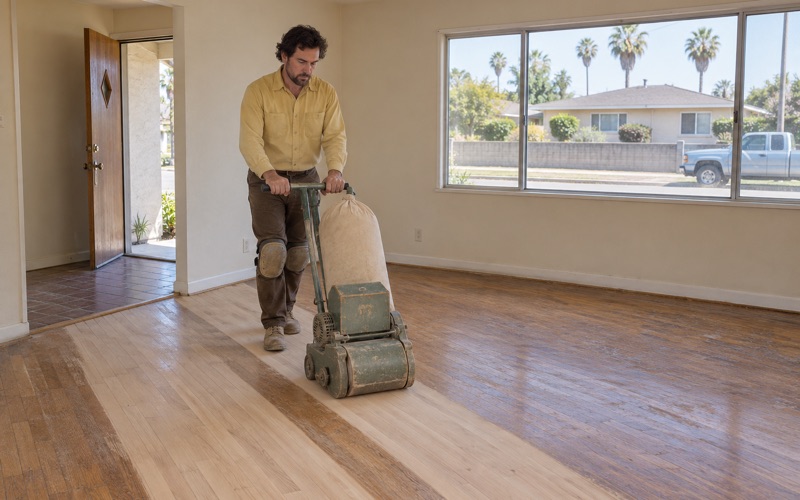
Los Alamitos sits inside the South Coast Air Quality Management District, which covers all of Orange County. We choose finishes from products legal to apply in the basin under the SCAQMD Rule 1113 limit of 275 g/L for wood coatings, which usually means a waterborne polyurethane or a compliant oil-modified or hardwax oil product. Sheen and color are chosen with you on sample boards.
We sand with containment and a dustless sanding system wherever the room allows, and every job gets a written cure schedule. A household living through the work knows when each room can be walked on in socks, when furniture can go back, and when it is fine to sleep there again. Rugs wait longest, because a fresh finish needs air to cure.
Timing Around the Weather
The forecast zone covering the city is Orange County Inland, not the coastal zone next door, and we watch that forecast before long refinishing jobs. Humid, rainy stretches slow drying and curing, and a floor that was wet recently needs dry readings before any finish goes on. We would rather move a date than seal moisture under a new coat.
Before the Work Starts
Construction permits in Los Alamitos run through the Development Services Department’s Building and Safety Division, which has an online Building Permit Center. If a repair reaches into framing or plumbing, we confirm with that office what the job needs rather than guessing. Bring any association approvals and your insurer’s claim number to the first visit, and we will fold them into the plan.
When you call, tell us whether water is involved, when it happened and whether the source is fixed. We will come out, open what needs opening, take readings and give you a written estimate. If the floor can be saved, we will say so, and if it cannot, you will know exactly why before any money is spent.
- 20+ Years With Wood Floors
- Written, Itemized Estimates
- Low-VOC South Coast Finishes