Hawthorne Wood Flooring has spent more than 20 years on wood flooring in Lomita and the rest of the South Bay, and the first thing we do on any job here is look at the floor as it actually sits. Refinishing, board repair, stairs and new installs all start with a walk across the room, a straightedge and a moisture meter, before a single number goes on paper.
That habit matters more in some houses than others. An older floor that dips toward one wall, a board run that has opened a gap, or a finish that cracked along a straight line can each have a simple cause or a more involved one, and the difference changes what the job should be. We would rather find that out on the first visit than halfway through sanding.
This page covers what shapes floor work in this city specifically: what the city’s own planning documents say about the ground, how old most of the housing is, how we read a floor that has settled, and how moisture, old materials, air-quality rules and rental turnovers fit into a realistic plan and a written estimate.
Floors on Faulted Ground: What Lomita’s Housing Element Says
Most homeowners never read their city’s Housing Element, but Lomita’s version is unusually direct about the ground under the city. The 2013-2021 edition, published in February 2014, places Lomita on a rolling plain just northeast of the Palos Verdes Hills, in an area bounded by two of the most active faults in Southern California: the Palos Verdes fault to the south and the Newport-Inglewood fault to the northeast.
The Palos Verdes Fault and the Southern Tip
The element states that the Palos Verdes Fault zone runs along the northeastern section of the Palos Verdes Hills and crosses the southern tip of the City of Lomita. It also notes that the Newport-Inglewood fault sits about five miles from the city, with the Torrance-Wilmington fault also to the northeast.
What the element does not do is draw that crossing onto a named street or parcel, and neither do we. A general statement about a fault zone is not a verdict on any single house. It is a reason to look carefully at a floor rather than to assume anything about it, in either direction.
Liquefaction Named as a Constraint
The same document says development in Lomita may be constrained by the presence of the Palos Verdes Fault in the southern section of the city and by the presence of liquefaction hazards. It adds that projects on land with geologic constraints would require special engineering design.
For a flooring contractor, that line sets a boundary. We refinish, repair and install floors; we do not diagnose soil or structure. When a floor shows movement that looks bigger than wood behavior, we say so plainly in writing and suggest the owner bring in the right engineer before we price anything that depends on the answer.
The Southern Hillside Blocks
The element describes the southern portion of Lomita as hillside. It also records that numerous landslides have occurred on the Palos Verdes Peninsula, yet its review of the Los Angeles County Safety Element found no definite or probable landslide hazards within Lomita, and it notes that the hillside areas are largely developed, paved and landscaped.
So the hillside streets are not a warning sign in themselves. They are simply ground with more grade than the flatter blocks to the north, and houses built into grade can show floors that were framed or have aged out of level. We check each one individually, because the map describes a district and the floor belongs to one house.
Looking for wood-flooring closer to Palos Verdes Estates? See Wood-Flooring in Palos Verdes Estates.
Uneven or Cracked Floors in Older Lomita Houses
Age explains most of what we find under Lomita floors. Of the city’s 7,904 housing units, 78.9 percent were built before 1980, and the 1950s, 1960s and 1970s were nearly level building decades, together accounting for 62.5 percent of the stock. Along Lomita Boulevard and Narbonne Avenue, the parcels in the Mixed Use Overlay have a median construction year of 1948.
Why Older Floors Move
A floor that has been down fifty or seventy years has lived through decades of seasonal swelling and shrinking, plumbing leaks, furniture loads and remodels. Boards cup when moisture comes from below and crown when a cupped floor was sanded flat too soon. Squeaks come from fasteners that have loosened, and board gaps open where the wood has dried and shrunk over time.
None of that requires a dramatic explanation, which is exactly why we measure before we guess. Most sloping floors in older houses trace to ordinary causes: a sagging floor joist, a subfloor softened by an old leak, or a room added later that never quite matched the original level.
How We Read a Settled Floor
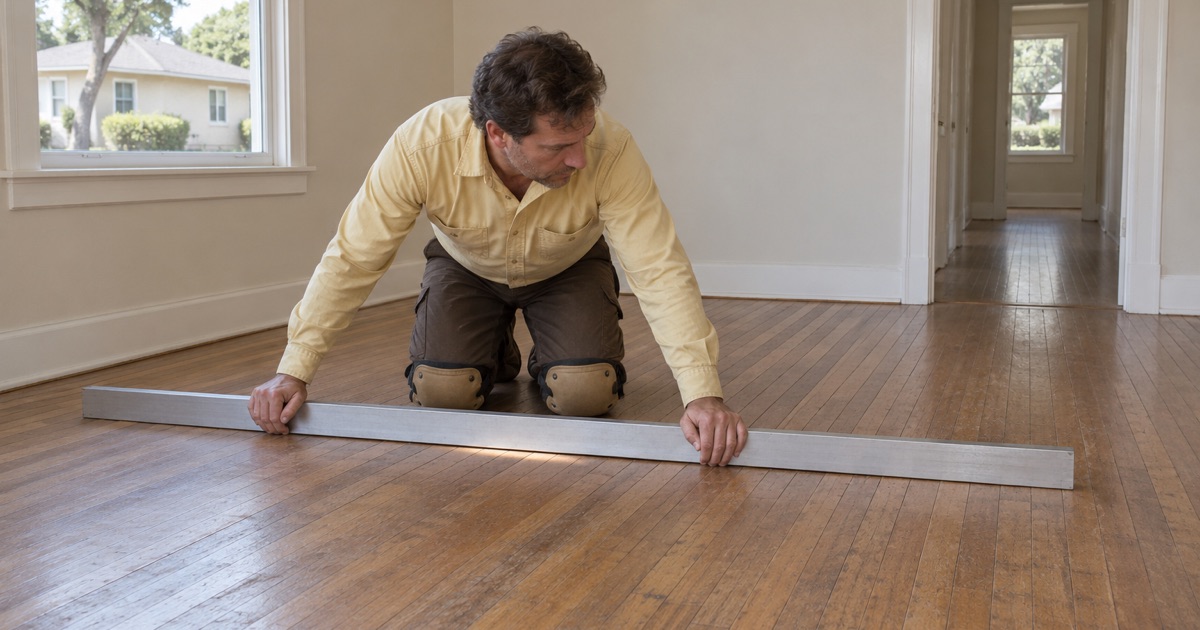
We start with a long straightedge and a level across the room in several directions, noting where the floor dips, where it humps and how far the change runs. We look for cracks in the finish, split boards, and gaps that line up with a wall, a doorway or a plumbing run, because the pattern usually points to the cause.
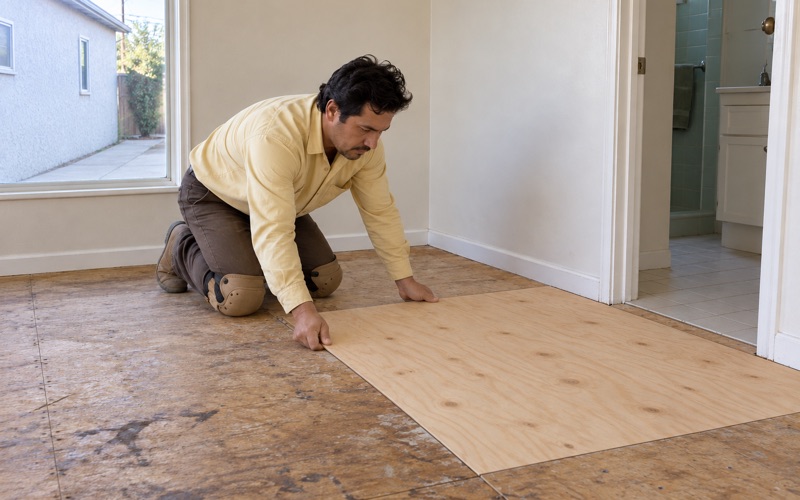
Where we can, we open the floor or look from below to check the subfloor and joists. Soft spots, water-swollen sheathing and loose joists are much cheaper to deal with before a finish floor is priced than after it goes down, and a callback on a new floor is the outcome everyone wants to avoid.
Repair, Weave-In or Replace
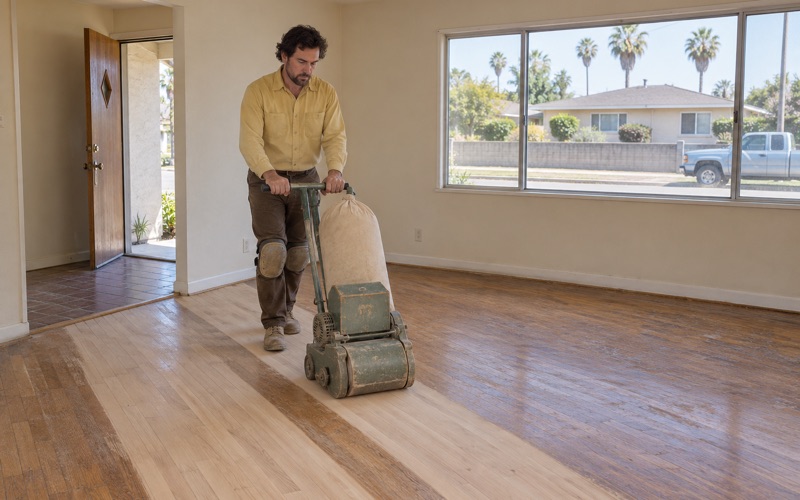
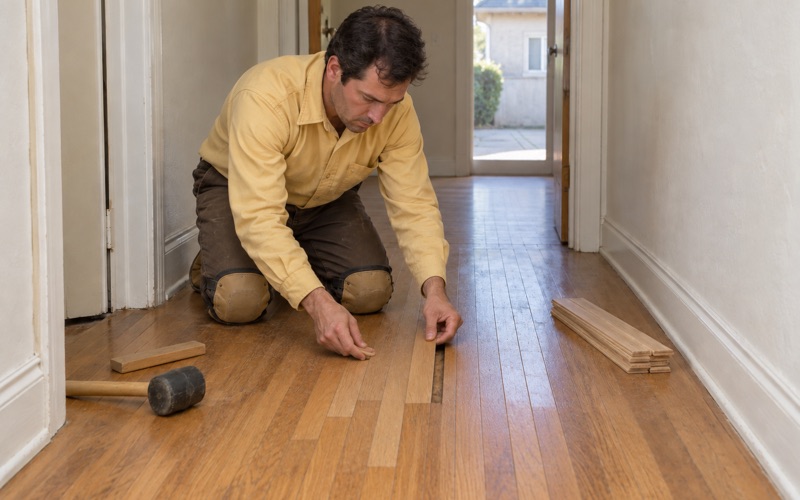
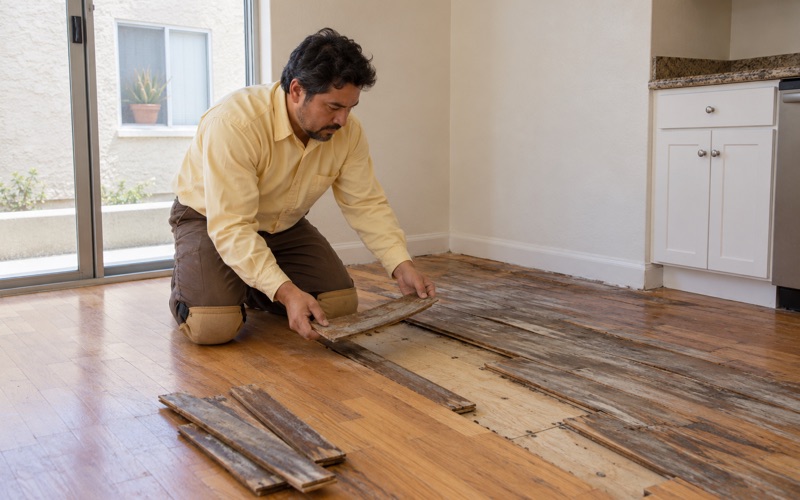
When the cause is local and settled, the answer is often board replacement or a weave-in repair, where damaged boards come out and new ones are laced into the existing pattern so the patch disappears after sanding. When a floor is sound but tired, a full sand and refinish or a screen and recoat may be all it needs.
If the movement is ongoing or larger than a flooring fix can address, we write that down and stop there. A new floor laid over an unresolved problem inherits the problem, and we would rather lose a job than install boards we expect to crack.
Moisture and the Ground Beneath a Floor
Moisture is the other ground condition that shows up in wood. Lomita sits on the southern end of the Torrance plain, above water-bearing sediments that form a complex system of interlayered aquifers, and the city lies within the West Coast groundwater basin.
Groundwater at About 30 Feet
The Housing Element cites a Los Angeles County Safety Element estimate that groundwater sits about 30 feet below ground level in and around Lomita, and it says that depth makes the area conducive to perched water conditions, where water collects above the main water table. The same element rates the city’s soils as a slight to moderate erosion hazard and not a housing hazard.
We treat that as context, not a diagnosis. A general groundwater estimate does not tell us whether moisture is reaching a particular floor. Readings taken in that room do, which is why the meter comes out before the order form.
Measuring Before Material Is Ordered
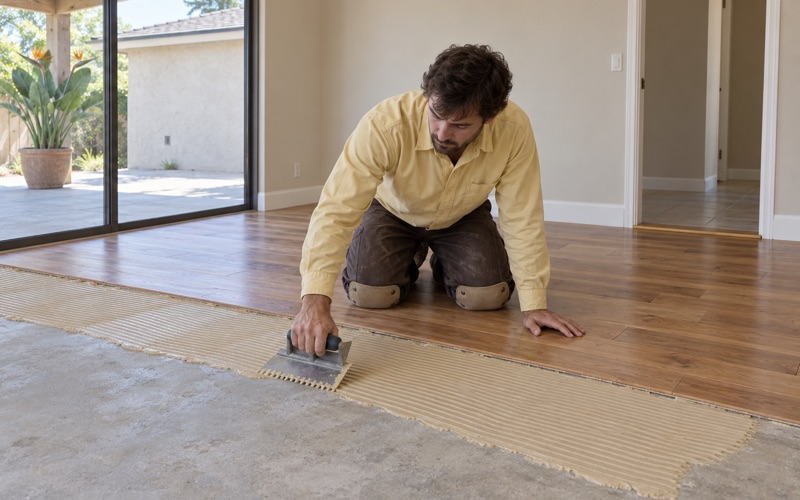
We measure moisture content in the existing wood and in the subfloor, and where a floor will go over concrete we test the concrete as well, using the ASTM F2170 in-situ relative humidity test or a calcium chloride test as the situation calls for. Every reading goes into the estimate so the owner can see it.
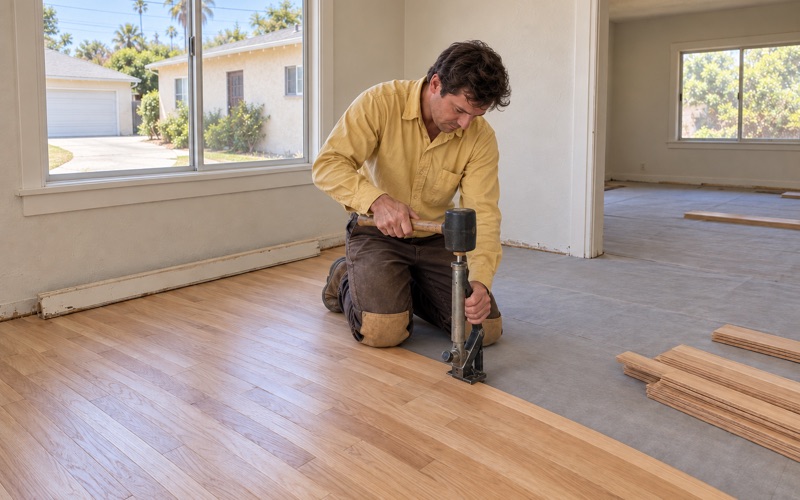
New boards then acclimate in the house to NWFA installation guidelines before they go down. Skipping acclimation is one of the most common reasons a new floor cups or gaps in its first year, and it costs nothing but a few days of patience.
Flood Maps and Leaks
The 2014 element placed Lomita in FEMA Zone C, where minimal flood hazards exist, and found no dam-inundation exposure for the city. That is a citywide description from a dated document, not a statement about any address today, so we leave current flood questions to the owner and the official maps.
In practice, the water that damages Lomita floors usually comes from inside: a supply line, a water heater, a dishwasher, or a leak from the unit upstairs. When that happens we trace the source, photograph the damage and record moisture readings in a form an insurance adjuster can use.
Planning Floor Work in Lomita
Once we know the floor is sound and dry, planning comes down to materials, rules and timing. Lomita incorporated on June 30, 1964, and building and safety services here are provided by Los Angeles County Public Works under contract, from the Lomita-Lennox Building and Safety Office at 24320 S. Narbonne Ave.
Older Houses, Old Materials
With most of the housing built well before 1978, we follow lead-safe work practices under the EPA Renovation, Repair and Painting rule whenever a job disturbs painted surfaces such as baseboards, shoe molding or stair parts. Dust containment and HEPA vacuuming are part of the job, not an upgrade.
Old 9x9 tile and black mastic under a floor get treated as a possible asbestos question before anything is sanded or scraped. Carpet pad, staples and tack strip come up completely and the holes are filled before sanding, so oak found under carpet refinishes clean instead of showing a grid of old fastener marks.
Finishes That Meet South Coast Rules
Lomita is in the South Coast Air Quality Management District, and every finish we use is legal to apply under SCAQMD Rule 1113 and its 275 g/L limit for wood coatings. That still leaves real choices: waterborne polyurethane for low odor and a clear look, oil-modified polyurethane for warmth, or a hardwax oil finish for a softer sheen.
We walk through sheen level, stain samples on the actual floor and species hardness on the Janka scale before anything is decided, so a red oak or white oak floor ends up the color the owner pictured instead of an orange or blotchy surprise.
Rented Houses and Turnover Dates
For owners of a rented house, duplex or fourplex, we work to the turnover date they give us and choose finishes that hold up between tenants. Estimates and invoices are written and itemized, so a landlord or tenant can use them at move-out under California deposit law.
On upstairs units and condos, we choose underlayment with the neighbor below in mind and read the building’s own rules before work starts, which avoids stopping a job midway over an association requirement nobody checked.
Stairs, Scheduling and the Written Estimate
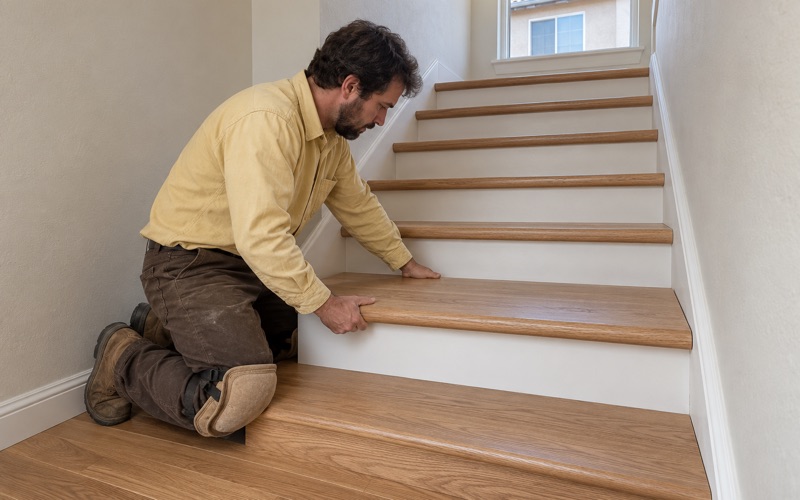
Stairs are priced per tread and riser rather than folded into a square-foot number, since nosings, returns and risers take far more hand work than open floor. Every estimate includes a written cure schedule showing when each room can be walked on, furnished and slept in.
That schedule lets a household plan around the job instead of guessing. Combined with the moisture readings, subfloor notes and any findings about a settled or cracked floor, it gives a Lomita owner one document that explains what we found, what we recommend and why.
- 20+ Years With Wood Floors
- Written, Itemized Estimates
- Low-VOC South Coast Finishes