
Hawthorne Wood Flooring does hardwood floor repair across Hawthorne, CA, serving surrounding cities including Del Aire, Lennox, Alondra Park, Lawndale and West Athens. For more than 20 years we have replaced damaged boards, flattened cupped floors, stopped squeaks and patched termite and pet damage so the repair blends into the floor around it rather than standing out as a patch.
The repair itself is usually the easy part. The harder work is figuring out why the floor failed, because a board that cupped from a slow leak, a floor that gapped because it was installed wet and a soft spot over a rotted subfloor all look like the same problem from above. We measure moisture, check fasteners and look under the house where we can before we price anything.
Most of our repair work is in older houses and rental units, where a floor may have been patched before, carpeted over or refinished several times. That history shapes what can be done, so we check how much wood is left above the tongue and what finish is on the floor before recommending a repair or a refinish to go with it.
Replacing and Weaving In Damaged Boards
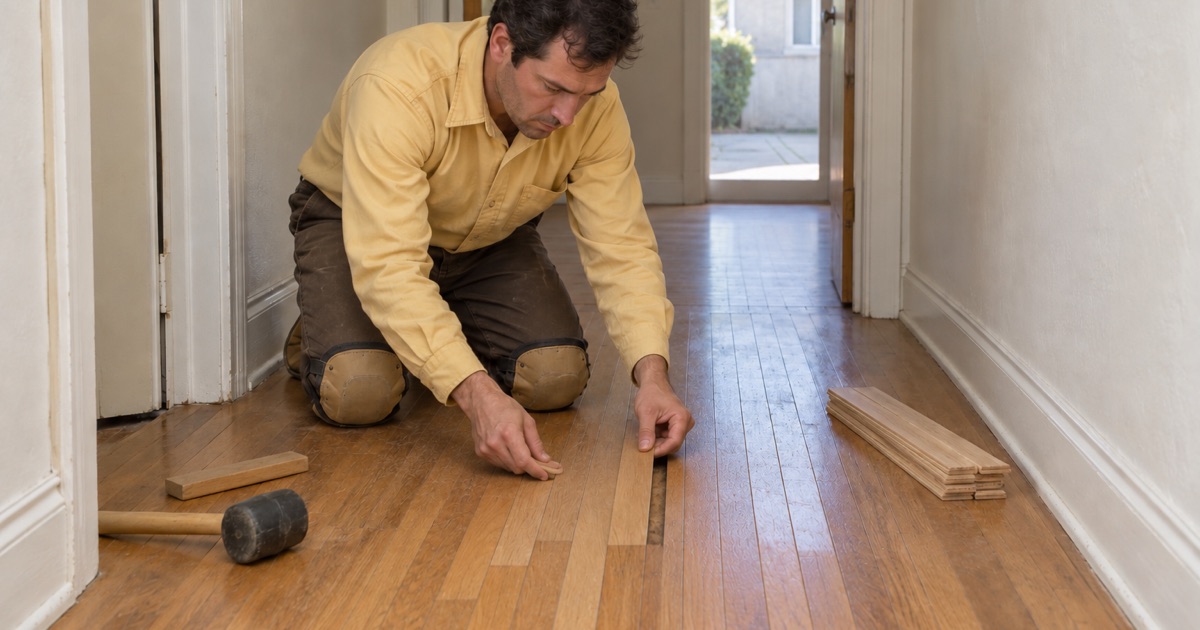
Cutting Out Boards Without Disturbing Their Neighbors
Hardwood strips lock together with a tongue and groove, so a damaged board cannot simply be lifted out. We cut it lengthwise, remove the pieces and trim the groove edge of the replacement so it drops into place. The new board is then glued and face-nailed where needed, and the nail holes are filled.
Done carelessly, this is where repairs go wrong. A saw run too deep scores the subfloor, and a chisel pried against a neighboring board cracks its edge. We take the extra time to keep the damage limited to the board being replaced.
Weave-In Repairs That Follow the Floor Pattern
Where several boards in a row are damaged, cutting a straight line across them leaves an obvious seam. A weave-in repair staggers the replacement boards so their ends fall at different points, the way the original floor was laid. The result is a repair you have to look for, rather than a rectangle that shows from the doorway.
Weave-ins are also how we close up floors where a wall was removed or a floor register was relocated. The old opening is filled with boards laced into the surrounding rows, so the room reads as one continuous floor instead of showing where the house used to be divided.
Matching Species, Width and Color
We identify the species first, since red oak, white oak and maple are often confused once finished. Then we match the board width and thickness, which varied in older houses. Color is the last step: new wood is lighter, so we stain it to blend, or recommend refinishing the room so old and new boards share one finish.
Moisture Damage: Cupping, Crowning, Buckling and Gaps
Cupped and Crowned Boards
Cupping is when board edges rise above their centers because the underside is wetter than the top. Crowning is the reverse, often seen after a cupped floor was sanded flat before it dried out. Both are symptoms, so we find the moisture source with a meter, whether a crawlspace, a slab or a leak, before touching the floor.
Once the source is fixed and the wood has dried to a normal moisture content, many cupped floors settle back close to flat. We take readings over days or weeks to confirm that before sanding, because sanding too early is how a cupped floor becomes a crowned one.
Buckling Floors That Have Lifted
Buckling is the most serious moisture failure. The boards swell until they push against the walls and lift off the subfloor, sometimes by several inches. We relieve pressure at the perimeter, dry the floor and then assess each area. Boards that have cracked or torn free of their nails are replaced, and the rest are refastened.
Buckling almost always involves a lot of water, from a burst supply line, a failed water heater or a leak from an upstairs unit. We photograph the floor and record moisture readings before any boards are removed, because that record is what an insurer will ask for when the claim is reviewed.
Gaps Between Boards
Some gaps open and close with the seasons, and that is normal for solid wood. Gaps that stay open all year often mean the floor was installed too wet and shrank, or that it has lost its fasteners. Depending on the cause, we fill them with a flexible filler, refasten loose boards, or replace a section with boards installed at the right moisture content.
Termites, Beetles and Pet Stains
Drywood Termite Damage
Drywood termites live inside the wood they eat, so the first signs are often small kick-out holes and piles of pellet-shaped frass near a baseboard. A board can be hollow under a sound-looking surface. We recommend a licensed pest inspection and treatment first, then replace the damaged boards, since repairing wood that still has live termites only feeds them.
Powderpost Beetles in Older Floors
Powderpost beetles leave tiny round exit holes and fine, flour-like dust. They are less common in finished floors than in raw lumber, but they turn up in older houses with untreated subflooring. We replace weakened boards and advise on treatment before any refinishing, so new finish is not applied over wood that is still active.
Pet Urine That Has Soaked Into the Wood
Urine that sits on a floor penetrates the finish and reacts with the tannins in oak, turning it dark gray or black. Light stains may sand out, but deep ones go through the board. We test-sand each stain, and where it will not lift, we cut out those boards and weave in new ones rather than finishing over a dark shadow.
Odor is the other half of the problem. Urine that has reached the subfloor keeps smelling after the boards are replaced, so we check the plywood underneath when we lift a stained board and seal or replace the affected area. That step is especially important in rentals, where the next tenant may notice the smell before anything else.
Squeaks, Loose Boards and Surface Damage
Stopping Squeaks at Their Source
Squeaks come from wood rubbing against wood or against a loose nail as the floor flexes. From above, we drive trim-head screws or cleat nails through the floor into the joists and fill the holes. From below, in a raised-foundation house, we can add blocking or shims between the subfloor and the joists. The method depends on what the crawlspace allows.
A squeak that returns after refastening often points to a deeper issue, such as a joist that has dried and shrunk away from the subfloor. We check the structure when that happens rather than adding more fasteners.
Gouges and Deep Scratches
Scratches in the finish buff out with a screen and recoat, but gouges into the wood need filling, sanding or replacement. We match wood filler to the species for small dents and replace the board where a gouge is too deep or too long for filler to look right. Moving heavy furniture on pads prevents most of this damage.
- 20+ Years With Wood Floors
- Written, Itemized Estimates
- Low-VOC South Coast Finishes