
Hawthorne Wood Flooring installs engineered hardwood flooring throughout Hawthorne, CA, serving surrounding cities including Del Aire, Lennox, Alondra Park, Lawndale and West Athens. After more than 20 years of putting wood floors into local houses, we recommend engineered boards wherever a solid floor would struggle, which in this area usually means over a concrete slab, in an upstairs condo, or in a kitchen that sees humidity swings.
Engineered flooring is not one product. The planks sold under that name range from thin veneers on fiberboard to thick sawn wear layers on multi-ply cores, and they install in three different ways. Choosing well means matching the board to the subfloor and to how long you plan to keep the house, so we look at both before we show you samples.
We test the slab or the wood subfloor for moisture before ordering anything and write the readings on your estimate. That step matters more with engineered floors than most people expect, because a moisture problem under a glued floor does not show until the boards begin to lift.
How Engineered Hardwood Is Built
Engineered Core Construction
An engineered board has a hardwood top layer bonded to a core of cross-laid plywood plies or a high-density wood composite. Because the layers run in different directions, the board moves far less with changes in humidity than a solid plank of the same width. That stability is what lets engineered wood go over concrete and be laid in wider boards.
Core quality varies. Multi-ply plywood cores hold fasteners well and tolerate small subfloor imperfections, while some composite cores are stiffer and flatter but less forgiving if they get wet at the edges. We explain the difference for each product you are considering.
Wear Layer Thickness and Future Refinishing
The wear layer is the real wood on top, and it decides the floor’s future. A thin wear layer can be screened and recoated but not sanded, while a thicker layer can be fully sanded and refinished, sometimes more than once. If you plan to stay in the house for decades, the extra cost of a thicker wear layer is usually money well spent.
Sawn and sliced wear layers also look different from rotary-peeled ones, which can show a wide, plywood-like grain. We bring samples of each so you can see the grain pattern in your own light, and we point out which products the manufacturer says can be sanded and how many times.
Species, Hardness and Factory Finishes
Engineered floors come in white oak, red oak, hickory, maple, walnut and many other species. The Janka hardness rating of the top layer tells you how well it resists dents, which matters in a house with children, dogs or rolling chairs. Most engineered boards arrive prefinished, so the room can be used as soon as the last board and trim are in.
Factory finishes are cured under ultraviolet light and are often harder than anything applied on site. The trade-off is the small bevel along each board edge, which catches dirt in a kitchen. If you prefer a flat, seamless surface, we can install unfinished engineered boards and sand and finish them in place like a solid floor.
Engineered Floors Over Concrete Slabs
Testing the Slab Before Anything Is Ordered
A slab-on-grade gives off moisture from the ground beneath it, and the amount varies house to house. We test using the ASTM F2170 in-situ relative humidity method, which reads moisture inside the slab, or a calcium chloride test where the manufacturer calls for it. The result decides whether the slab is ready, needs a moisture barrier, or is not suitable for wood at all.
We also look for the causes behind a wet reading. A sprinkler head spraying the foundation, a planter bed against the wall or a slab that was never given a vapor barrier each call for a different fix, and some are cheaper to correct outside the house than to seal against inside it.
Glue-Down Installation
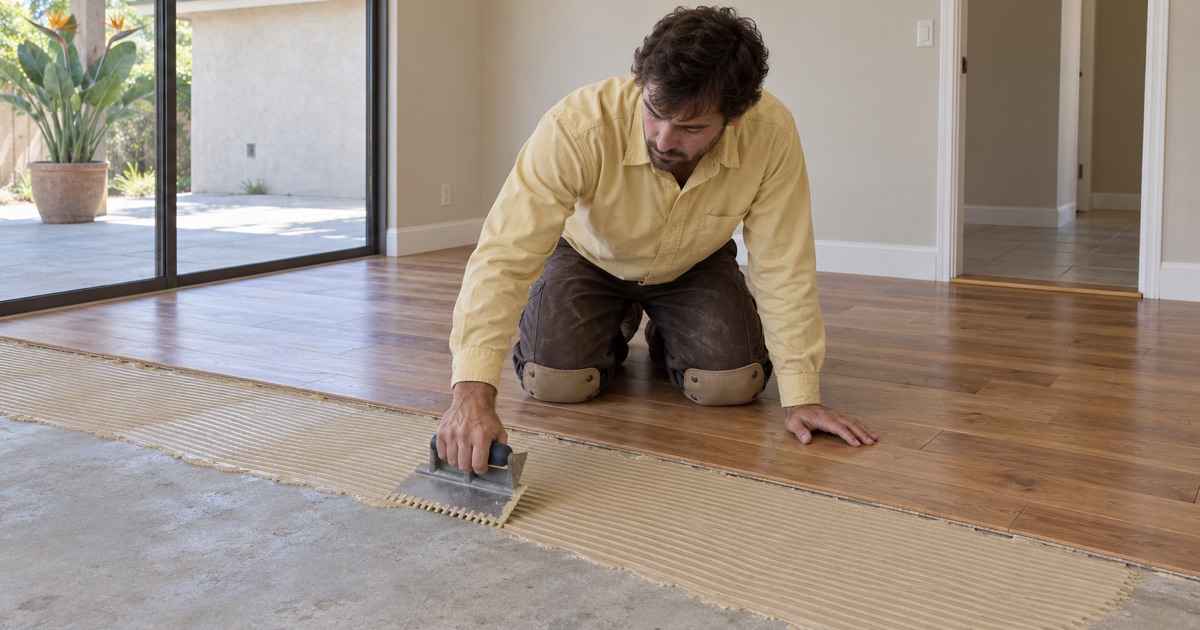
Gluing engineered planks directly to concrete gives the most solid feel and the lowest floor height, which helps where the new floor has to meet existing tile or a sliding door track. We use adhesives the manufacturer approves, many of which also act as a moisture barrier, and we flatten high and low spots in the slab first so every board is fully bonded.
Hollow spots under a glued floor are the usual cause of a board that clicks or cracks at the edge. We trowel the adhesive at the coverage the manufacturer specifies, roll the boards where required and keep weight off the floor until the adhesive has set, rather than moving furniture back the same afternoon.
Floating Installation Over a Vapor Retarder
A floating floor locks board to board and rests on an underlayment rather than being fastened down. Over concrete, that underlayment includes a vapor retarder. Floating floors go in quickly and can be replaced later without scraping adhesive, but they need a proper expansion gap at every wall and cannot be pinned under heavy cabinets.
Nail-Down Over a Wood Subfloor
In raised-foundation houses with a plywood subfloor, many engineered floors can be nailed or stapled down like solid wood. That gives a firm, quiet floor without adhesive. We check the subfloor for flatness and for loose or water-damaged sheathing first, because fasteners will not hold in plywood that has delaminated from an old leak.
Engineered Wood in Condos and Upstairs Units
Acoustic Underlayment and the Neighbor Below
Hard floors carry footstep noise into the unit below far more than carpet does. On upstairs installs we choose an acoustic underlayment rated for the job, and where the association sets a minimum sound rating, we select a product that meets it and keep the documentation for your records.
Underlayment is only part of the answer. Sound also travels through walls and trim, so we leave a small gap at the perimeter and fill it with a flexible sealant rather than pinning the floor tight against the drywall. That detail keeps footsteps from ringing through the building structure.
Association Rules Before the First Board
Many condo associations require written approval before carpet is replaced with hardwood, and California’s Civil Code 4760 governs how an association handles an owner’s alteration request. We read your building’s rules first, prepare the product details the board usually asks for, and plan around limits on working hours, elevator use and debris removal.
Formaldehyde Limits and Product Labels
What CARB Phase 2 and TSCA Title VI Mean for You
The cores and glues in engineered flooring can release formaldehyde. California’s limits under 17 CCR 93120.2, known as CARB Phase 2, and the federal TSCA Title VI standard set the ceiling for composite wood products sold here. We install only products labeled as compliant, and we can show you the label from the box for any floor we put down.
Why Cheap Imports Can Be a Risk
Most reputable manufacturers meet these limits without difficulty. The concern is with unlabeled or gray-market product bought online at a price that seems too good to be true. If you are supplying your own flooring, we check the labeling before installation, because a floor that fails the standard is not something you can fix once it is down.
- 20+ Years With Wood Floors
- Written, Itemized Estimates
- Low-VOC South Coast Finishes