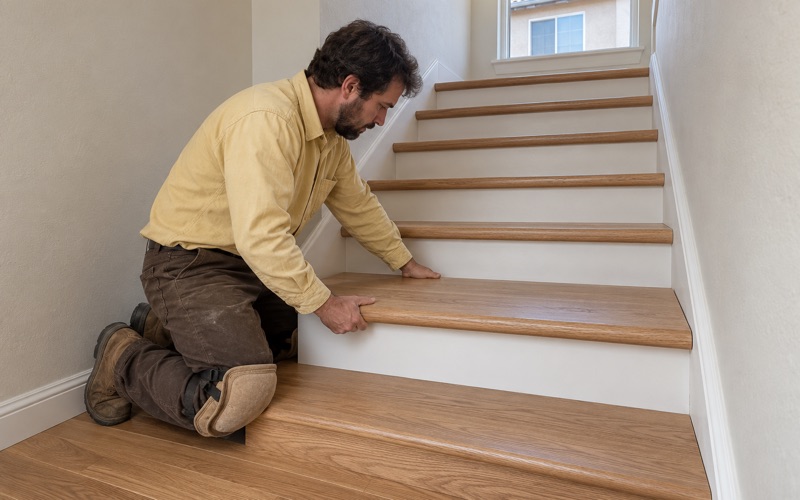
Hawthorne Wood Flooring has spent more than 20 years on wood flooring in Del Aire and the surrounding South Bay, and most of that work has been in houses whose owners have lived with the same boards for a long time. We refinish worn oak, repair damaged sections, rebuild stairs and install new solid or engineered floors, and every job starts with the same step: looking at what sits under the surface before we quote a number.
That inspection matters here because the house type is consistent and the paperwork is not always what people expect. A floor that looks like a simple sand and recoat can turn out to have old carpet pad glued to it, a patch of swollen sheathing near the kitchen, or tile and black mastic hidden under a later layer. We find those things first, write them down, and price the job around what is really there.
The estimate you get is itemized line by line, from sanding and board replacement to stair treads and shoe molding. Moisture readings in the wood are recorded before any material is ordered. Dust is contained, and a written cure schedule tells you which rooms can be walked on, furnished and slept in on which day.
A Hawthorne Address, a County Community
Many Del Aire homeowners give a Hawthorne mailing address, and that small detail causes real confusion when a project goes beyond refinishing. Del Aire is an unincorporated community of Los Angeles County, governed by the County Board of Supervisors. Its ZIP codes are 90250, which it shares with Hawthorne, and 90304. The envelope says one thing; the governing offices say another.
Six Annexation Attempts That Did Not Succeed
The gap between address and government is not an accident of mapping. According to a South Bay local-history account, the City of Hawthorne tried to annex the area in 1944, 1948, 1961, 1969, 1972 and 1983, and none of those attempts succeeded. In 1948 residents rejected annexation by a vote of 632 to 248, a margin that left little doubt about how they felt.
The 1961 election came far closer, carrying 150 to 140, but it failed after opponents challenged property valuations in court. After the later attempts also fell short, Del Aire stayed a County community, a compact place of just over one square mile in two segments joined by a narrow strip across El Segundo Boulevard.
Why It Changes a Floor Estimate
For most refinishing jobs, the governing jurisdiction never comes up. Sanding, staining and a fresh coat of waterborne polyurethane sit on top of the existing floor. The question arrives when a job reaches below the finish layer: replacing plywood subfloor, sistering a floor joist, or changing the floor system in a room that has had water damage.
When that happens, we plan the work around Los Angeles County rules and the Los Angeles County Title 26 Building Code, not around anything issued by the City of Hawthorne. City of Hawthorne rules, handouts and ordinances do not govern a house in Del Aire, even one with a 90250 address. We say so at the estimate stage so nobody is surprised later.
Looking for wood-flooring closer to Lennox? See Wood-Flooring Services in Lennox.
The County Offices Behind a Del Aire Floor Job
Three County-level or regional authorities can touch a Del Aire floor project, depending on how deep it goes and how old the house is. None of them matter for a light screen and recoat, and all of them can matter for a full tear-out. Knowing which applies is part of how we sequence a job.
Building and Safety for Work Below the Finish
Building review in unincorporated Del Aire belongs to Los Angeles County Public Works, Building and Safety. Whether a particular structural repair needs County review depends on the scope, and we raise that question with the homeowner and the County before any subfloor comes up, rather than guessing at the answer on site.
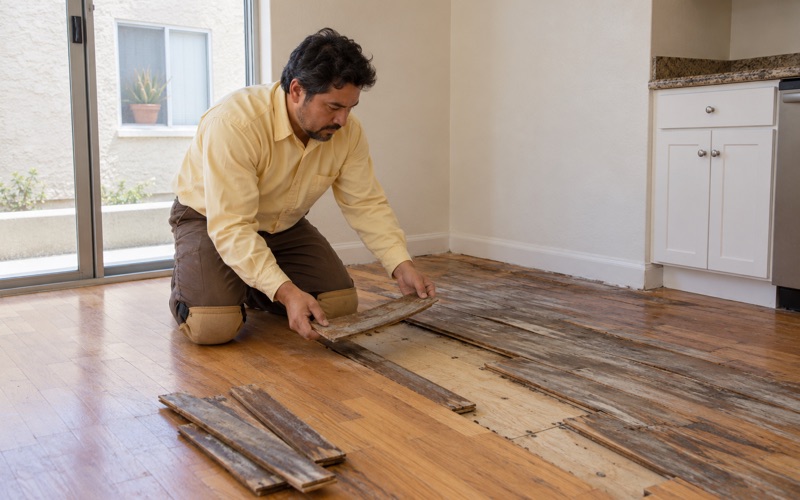
We open and check the subfloor before pricing any finish floor. Soft spots, water-swollen sheathing and loose joists get found at that stage, when they can be written into the plan, instead of weeks later as callbacks. If a leak caused the damage, we trace it back to its source and document it with photos and moisture readings an insurance adjuster can use.
The Air District and Your Finish
Del Aire sits in the South Coast Air Quality Management District, and that shapes what goes on the floor. SCAQMD Rule 1113 sets the VOC limit for wood coatings at 275 g/L, so every stain, sealer and topcoat we apply is a product legal to use in the South Coast air basin. That still leaves plenty of choice in color and sheen level.
The same district’s Rule 1403 governs asbestos disturbance. When we find 9x9 asbestos floor tile or black mastic under a later floor, we treat it as a possible asbestos question before anything is sanded or scraped. That can mean an asbestos survey first, which is slower than grinding it off, but far safer for the people living in the house.
Lead-Safe Work on Older Houses
The EPA Renovation, Repair and Painting rule applies to pre-1978 housing, and in Del Aire that covers most of the stock. By Census counts, 71.1 percent of the community’s housing units were built before 1980, so we plan for lead-safe work practices on any older house where painted baseboards, door casings or stair parts will be disturbed.
In practice that means containment, a HEPA vacuum and careful cleanup, done alongside our normal dust control for sanding. It adds some time to baseboard removal and stair work, and we include it in the itemized estimate rather than treating it as an extra charge that appears once the job is underway.
Owner Houses From the 1940s and 1950s
Del Aire is overwhelmingly a community of owners. Of 3,440 occupied units, 2,318, or 67.4 percent, are owner-occupied, and 97.2 percent of those owner households live in detached houses. The floors we see most often belong to people who have lived with them for years and plan to keep living with them.
The houses are also old in a very particular way. Census counts show 63.3 percent of Del Aire’s housing units were built before 1960, split almost evenly between the two decades: 1,080 units from the 1940s and 1,074 from the 1950s. The County’s South Bay Area Plan notes that the northern part of the community predominantly features residential buildings from the 1940s.
What Decades of Remodeling Leave Behind
Houses of this age have usually been through several rounds of flooring fashion. We often lift wall-to-wall carpet, then carpet pad adhesive, then rows of carpet tack strip nailed through the boards. Every staple, tack hole and flooring staple gets pulled and filled before sanding, which is what lets hardwood hidden beneath the carpet refinish clean instead of showing a grid of old damage.
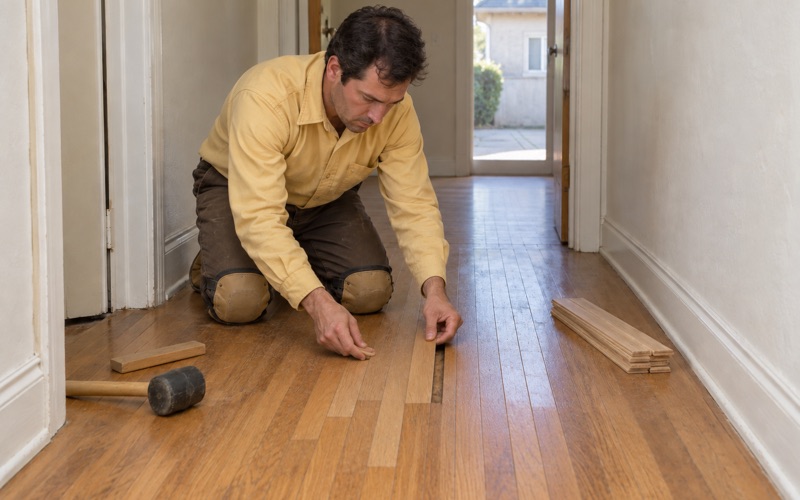
We do not assume what species is under the carpet until we see it. Once the boards are exposed, we check for cupping, crowning, board gaps and squeaks, and look for signs of drywood termite activity such as frass or kick-out holes. Damaged boards are handled with a weave-in repair so the new wood follows the grain pattern of the old.
Moisture Before Material
We measure moisture content in the existing wood with a wood moisture meter, and where a room sits on concrete we test the slab too, using an ASTM F2170 in-situ relative humidity test or a calcium chloride moisture test. The readings are written down before any new flooring is ordered and acclimated in the house.
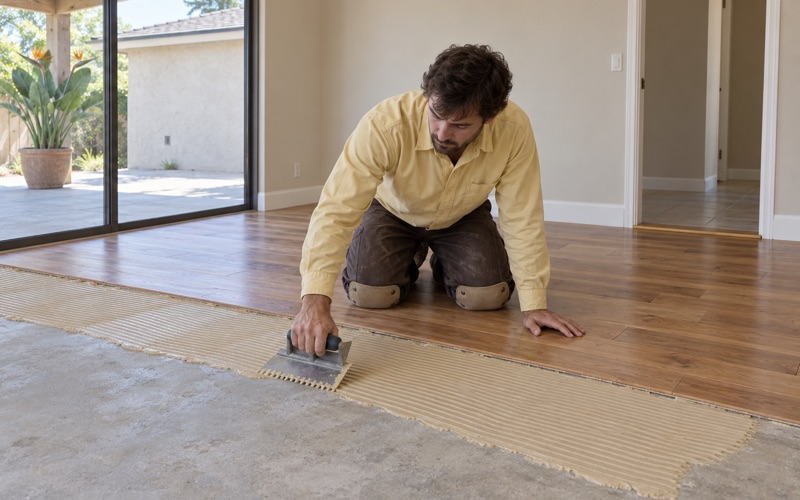
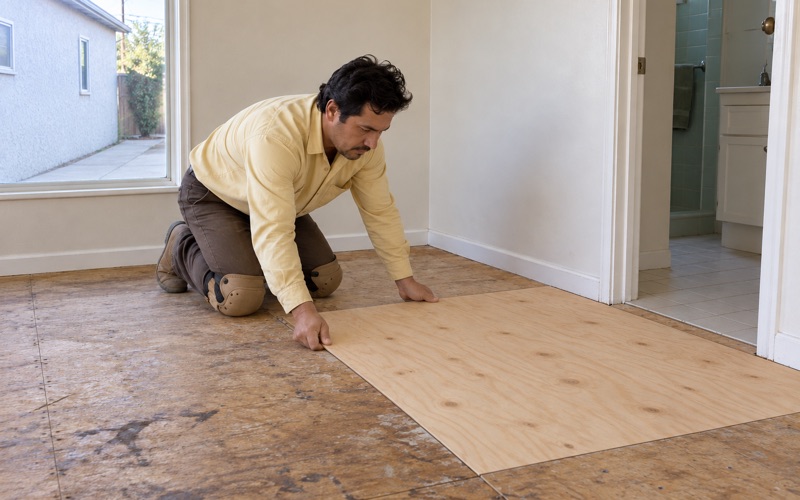
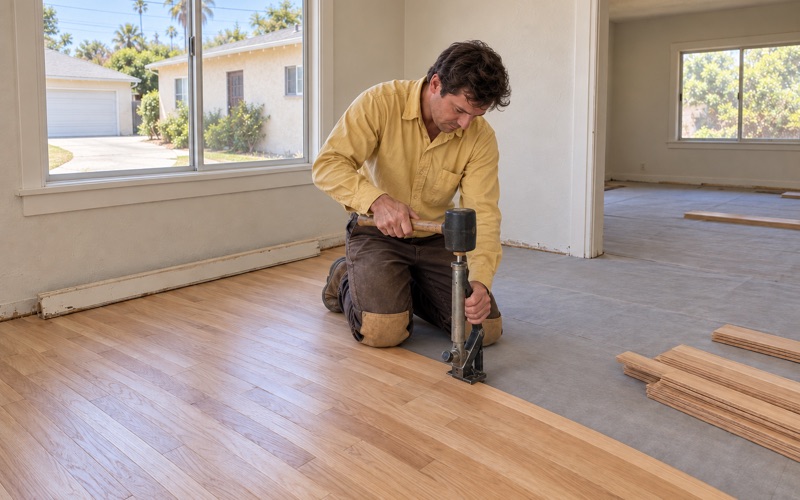
That step decides the installation method. Depending on what we find, a new floor might be nail-down over plywood subfloor, glue-down, or a floating installation with the right vapor retarder, following NWFA installation guidelines for expansion gap and acclimation. Getting the method right at the start is what keeps a new floor from buckling later.
Refinishing, Stairs and Living Through It
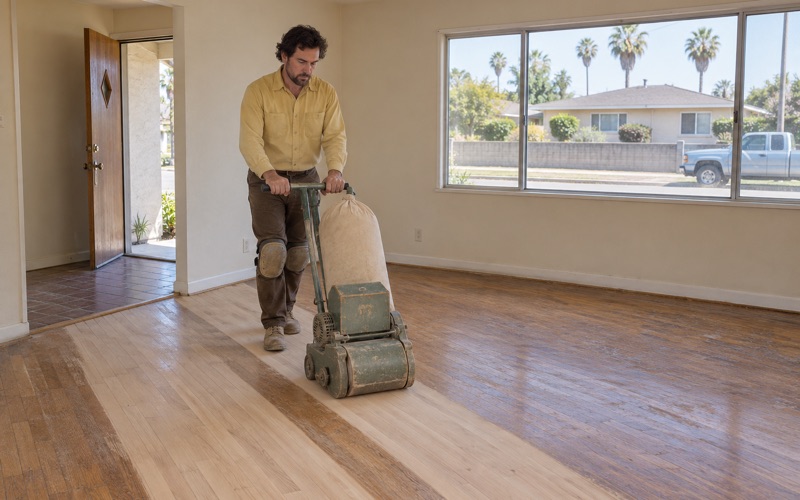
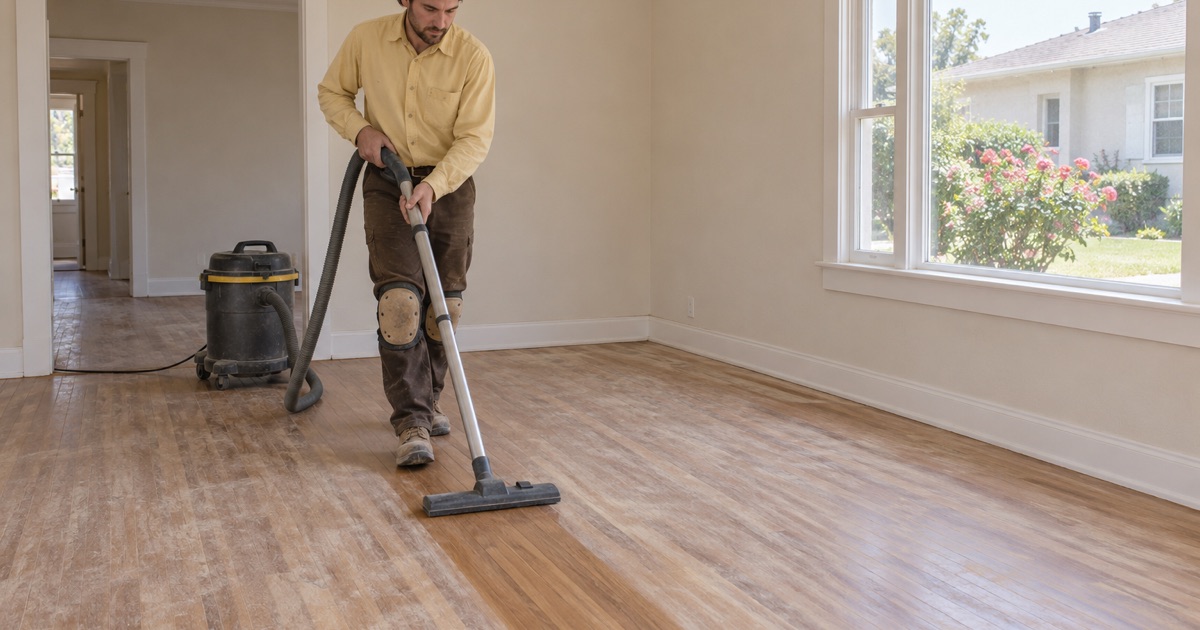
For a floor that only needs renewal, a screen and recoat can refresh the finish without full sanding. For worn or blotchy boards, we run a full grit sequence with a drum sander, edger and orbital sander, using a dustless sanding system, then apply a waterborne polyurethane, an oil-modified polyurethane or a hardwax oil finish.
Stairs are priced per tread and riser, not folded into a square-foot figure, because each stair tread, stair riser and stair nosing is its own piece of work. Since most Del Aire owners stay in the house during the job, the written cure schedule tells you exactly when each room is ready to use again.
When a Del Aire Home Is a Rental
The minority of Del Aire homes that are rented still add up to a meaningful number: 1,122 renter-occupied units, 32.6 percent of the occupied total. Some are single-family houses and some sit in larger buildings. Because Del Aire is unincorporated, the rental rules that apply are Los Angeles County’s, not a city’s.
The County Rent Ordinance
The Los Angeles County Rent Stabilization and Tenant Protections Ordinance, in County Code Chapter 8.52 and administered by the Department of Consumer and Business Affairs, covers rentals in unincorporated areas. Its full coverage reaches properties with two or more rental units and a certificate of occupancy on or before February 1, 1995.
That can matter to an owner planning larger flooring work in a covered building, since the County ordinance and state rules such as Civil Code 1946.2 on substantial remodels shape how tenant-occupied work proceeds. We are not the ones to interpret those rules for you, but we schedule and document the flooring work so an owner can follow whatever process applies.
Habitability Inspections
The County’s Rental Housing Habitability Program, run through Public Health, inspects unincorporated rentals, including tenant-occupied single-family homes, once every four years. Damaged, lifting or water-stained flooring is the kind of condition that shows up during an inspection, so some owners schedule repairs ahead of one.
Turnover Floors and Deposit Paperwork
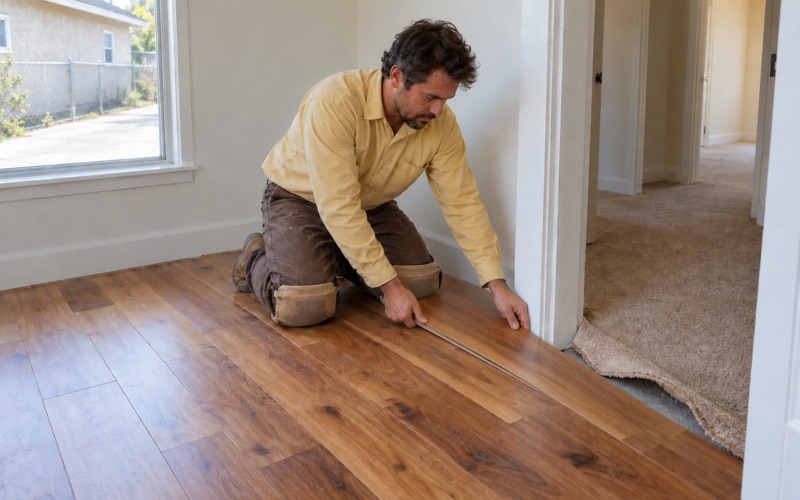
We finish rental floors to hold up between tenants and have them ready on the turnover date the owner gives us. That often means a durable finish, board replacement where pets or furniture did damage, and new reducer strip or T-molding at doorways.
Our estimates and invoices are written and itemized so a landlord or tenant can use them at move-out. Under Civil Code 1950.5, deductions from a security deposit must appear on an itemized statement of deductions, and the difference between normal wear and tear and real damage is easier to settle with a clear, line-by-line record of the repair.
- 20+ Years With Wood Floors
- Written, Itemized Estimates
- Low-VOC South Coast Finishes